.webp)

Security questionnaires, DDQs, and RFP security sections consume significant time for security, GRC, and pre-sales teams. Two tools that often come up when teams look to automate this work are Skypher and Conveyor.
Both aim to speed up security questionnaires with AI while keeping a human in the loop. However, they make different design choices on formats, workflows, Trust Center capabilities, and pricing.
Based on conversations with InfoSec, GRC, and pre-sales teams, seven dimensions usually matter most when evaluating tools for security questionnaire automation:
- Speed and accuracy
- Format and portal coverage
- Workflow and collaboration integrations
- Content management and governance
- AI and conversational experience
- Trust Center and buyer-facing experience
- Pricing and ideal customer profile
This article compares Skypher vs Conveyor across those seven dimensions so that security and commercial teams can decide which tool better fits their environment.
Skypher in brief
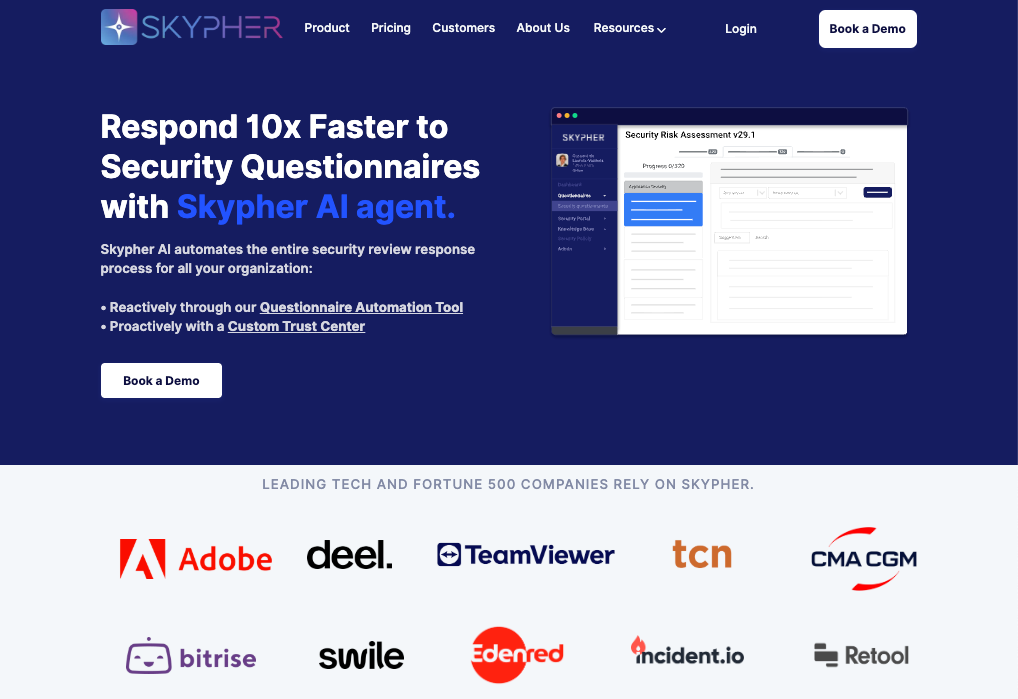
Skypher is an AI agent platform for automating security questionnaires, DDQs, and RFPs. It helps organizations speed up review cycles by up to 10x while maintaining around 96% accuracy. Skypher’s AI relies on three sources of information: approved answers from past questionnaires, internal documentation (including webpages), and a curated knowledge base.
Skypher is designed for scale-ups and enterprises that manage many extensive questionnaires each year, often across several products or entities. It handles complex Excel logic, detailed Word templates, PDFs, and online portals. Reviews and approvals are routed through enterprise tools such as Salesforce, Slack, and Teams.
The main strengths of Skypher are: support for complex formats, strong retrieval and grounding of AI answers, and its deep integration with other enterprise applications.
Conveyor in brief

Conveyor is a GPT-powered platform that automates security questionnaires and RFP responses. It also offers a Trust Center for secure document sharing. It focuses on high-accuracy automated answers and strong integrations.
Conveyor is aimed at mid to large organizations that regularly handle detailed security questionnaires and want a single environment for questionnaire automation and Trust Center management.
The main strengths of Conveyor are: multi-language support, browser-centric work, secure document controls, and analytics on how prospects and customers interact with shared security information.
Summary comparison table
Head-to-head comparison: Skypher vs Conveyor
Speed and accuracy
Why it matters: Speed and accuracy determine whether these tools actually save time or just move the bottleneck. If AI drafts are fast but unreliable, security teams end up rewriting everything and lose trust in the system. A good tool needs to cut turnaround from days to hours while producing answers that reviewers can validate quickly, not clean up from scratch.
Skypher
Skypher focuses on fast, high-confidence responses for large and complex questionnaires. It is positioned to deliver responses up to ten times faster while maintaining around 96 percent accuracy, even for multi-hundred-question security reviews.
It does this by combining a proprietary retrieval layer over past questionnaires, synced policies, and a curated knowledge base and popular generative AI model from OpenAI, Anthropic, and Meta.
Very little needs to be retyped. Each answer includes source citations and confidence scores, which makes review faster because security and GRC teams can immediately see where an answer comes from and how much they can trust it.
In practice, Skypher is optimized for teams that want to move from days to hours on large questionnaires while keeping review time predictable and audit-friendly.
Conveyor
Conveyor highlights speed through its AI-generated responses and browser-based workflows. It reports AI accuracy above 95 percent and up to 90 percent time savings on repetitive questionnaire tasks.
It generates automated answer suggestions across security questionnaires and RFPs, and its browser extension lets users complete questionnaires directly in web portals.
Conveyor is a strong fit for teams that spend a lot of time inside portals and want AI shortcuts in those environments, rather than exporting content to a different workspace.
How they compare
Both tools significantly reduce the time required to complete questionnaires. Skypher emphasizes a slightly higher stated accuracy and deeper automation for extensive, multi-format questionnaires.
Format and portal coverage
Why it matters: Format and portal coverage decide whether you truly automate questionnaires or still copy and paste by hand. If a tool cannot cope with complex Excel logic, long Word templates, PDFs, or locked-down portals, your team will keep doing manual workarounds. The right fit should handle the messy formats your customers actually use, not just ideal spreadsheets in a demo.
Skypher
Skypher is designed for real-world questionnaires across many formats. It supports Excel with macros, dropdowns, conditional logic, and evidence fields, long Word documents with nested tables and checkboxes, and PDFs with embedded tables or scanned sections. Skypher supports exporting questionnaires from online portals like Archer, OneTrust, and ServiceNow directly into its platform. This capability ensures users can leverage all of Skypher’s advanced features, especially collaboration, rather than being limited to basic autofill. Many competitors lack this, making it harder for teams to work efficiently on portal-based questionnaires.
Finally, Skypher also offers a browser extension that lets you answer questions wherever you are. For example, if a customer sends a question over email, you can open the Skypher extension and quickly respond. See how in the video below.
Conveyor
Conveyor is strong on web-based forms via a browser extension, letting users complete questionnaires directly in the browser instead of manually retyping. It can also ingest spreadsheets and Word documents.
How they compare
Both tools connect to customer systems and portals. Skypher is usually stronger if your main pain points are complex Excel logic, long Word documents, mixed PDFs, and questionnaire portals. Conveyor is more attractive if your team spends most of its time inside standard web portals and wants a browser extension to speed up that work without needing all the extra features that you’d get by working directly on the platform.
Workflow and collaboration integrations
Why it matters: Workflow and collaboration decide whether a tool becomes part of how teams already work or another system nobody logs into. If intake, reviews, and approvals sit in different places from your CRM and chat tools, you create extra friction and slower cycles. The best fit will plug into Salesforce, Slack, Teams, and your document stores so security, sales, and legal can work together without changing their daily habits.
Skypher
Skypher is designed to sit inside existing commercial and security workflows. Questionnaire intake and tracking happen directly in Salesforce, so RFPs and security questionnaires remain tied to opportunities, while reviews, comments, and approvals run through Slack or Microsoft Teams, so subject matter experts do not need to adopt a new interface. Roles and permissions are granular, allowing security, sales, legal, and product to see and edit only what they should. Content stays aligned through continuous syncing with OneDrive, SharePoint, Google Drive, Confluence, Notion, and your websites. In practice, Skypher behaves like an automation layer on top of systems you already use rather than a separate silo.
Conveyor
Conveyor covers core workflow needs, but the experience is more centered on running work inside Conveyor rather than embedding deeply into the tools teams already live in. It offers integrations with systems like Salesforce, Slack, and common document sources, yet many review, routing, and collaboration steps still happen within its own interface, which can create an extra workflow for security and commercial teams to adopt. In practice, Conveyor can work well for teams that want a centralized hub for security reviews, but it tends to behave more like a separate system of record than an automation layer that stays tightly coupled to existing CRM, chat, and content workflows.
How they compare
Both tools support collaboration and integrations. Skypher integrates more deeply with external workflows such as Salesforce, Slack, Teams, and document repositories, which suits organizations that want to keep work in the tools they already use. Conveyor centralizes more activity inside its own environment and browser extension, with analytics on usage and collaboration inside that ecosystem.
Content management and governance
Why it matters: Content management and governance determine whether each questionnaire makes the next one easier or you keep starting from scratch. Without a clear source of truth and review process, answers drift, versions multiply, and audit trails break. The right tool should turn every completed questionnaire and policy update into governed, reusable content that teams can trust months later.
Skypher
Skypher relies on three data sources: a knowledge base, past questionnaires, and synced documents. Reviewers or subject matter experts can be assigned to each knowledge base entry and receive regular reminders to review them. Past questionnaires can be set to expire automatically, ensuring only up-to-date answers are reused. Policies and documentation stay relevant through ongoing syncs with platforms like Google Drive, SharePoint, Confluence, Notion, and your website.
Conveyor
Conveyor positions its content management around a low-maintenance content library. Instead of relying on a large, manually maintained Q&A bank, it emphasizes generating accurate drafts by pulling from other sources, such as existing documents and past edits, which reduces the number of Q&A pairs teams need to curate. The goal is to minimize rewriting and manual busywork by having AI handle more of the end-to-end workflow, from initial draft generation to coordinating inputs across teams.
How they compare
Both tools aim to turn scattered answers into reusable content. Skypher places greater emphasis on tight alignment with external document repositories and on explicit review workflows with citations and confidence scores.
AI and conversational experience
Why it matters: AI and conversational experience shape how often people actually use the tool. If asking a question feels as easy as pinging a colleague, teams will rely on it for day to day work. If answers are opaque or hard to control, they stop trusting the assistant and fall back to manual searches. The right approach combines natural language interaction with clear grounding in your own content so reviewers can move faster without losing oversight.
Skypher
Skypher includes a conversational AI Agent that acts as a transparent assistant over all your security content rather than a black-box tool. Users can ask natural language questions, for example about backup plans or incident processes, and the agent searches across past questionnaires, company documents, and the knowledge base to return a clear answer grounded in those sources. Behind each response, you can inspect which documents were used, see how they were combined, and refine the output by excluding sources or asking the agent to adjust tone, length, or structure. The goal is to give security and GRC teams controllable, explainable drafts they can trust.
The same conversational experience is available where people already work. The agent can be used directly inside Slack and Microsoft Teams, in the web app, and through the browser extension. When security questions arrive by email, in chat, or in portals, users stay in context and let the agent draft and refine answers on top of approved internal content, then review wording and sources before replying. In practice, Skypher’s conversational interface turns unstructured questions into accurate, traceable responses while keeping humans firmly in control of what is actually shared.
Conveyor
On the Conveyor side, they also provide a conversational interface for both internal teams and external buyers. Internally, users can ask questions from Slack and Teams about security posture or specific questionnaires and receive drafted answers. TThose drafts are designed to be reviewed and edited before they are shared.
Externally, Conveyor offers a chat style assistant inside its hosted Trust Center. Visitors can ask natural language questions, request specific documents, and get cited answers that link back to the underlying Trust Center content. The assistant can also collect and bundle multiple documents into a single download while respecting NDA and access rules. Overall, Conveyor’s conversational experience is oriented around letting internal teams and customers self serve security information in Slack and in the Trust Center, with AI generated, source backed responses that are reviewed rather than sent as is.
How they compare
Both platforms use conversational AI to make security knowledge easier to access, but with different emphases. Skypher centers its agent on transparent, explainable answers for internal teams, with full visibility into sources and reasoning across the web app, Slack, Teams, and the browser extension. Conveyor combines internal chat in Slack and Teams with a customer facing assistant in the Trust Center, focusing more on self service for both buyers and internal stakeholders. The better fit depends on whether you care more about deep, inspectable answers for internal reviewers or broader self service across internal chat and a public Trust Center.
Trust Center and buyer-facing experience
Why it matters: For many prospects, the Trust Center is the first place they judge whether you are a serious, transparent vendor or a risk. If it is hard to use, out of date, or inconsistent with your questionnaire answers, deals slow down and extra review cycles appear. A good Trust Center should reduce back and forth, keep documents aligned with what you say in questionnaires, and give sales clear insight into how buyers engage with your security story.
Skypher
Skypher includes a built in Trust Center that is tightly connected to its questionnaire automation. It provides a secure, always up to date portal where prospects and customers can access security documentation, certifications, and audit reports. Access controls and approvals let you decide who sees which documents and gate sensitive items behind NDAs when needed. Because the Trust Center pulls from the same content and answers used for questionnaires, there is less risk of discrepancies between what appears in the portal and what is sent in responses. Activity can be tied back to sales workflows so teams can track how buyers interact with security content over time. The result is a consistent security narrative across questionnaires and shared documents.
Conveyor
Conveyor also offers a customer-facing Trust Center with secure document sharing. Organizations can publish a public or gated portal that presents security posture, policies, and key documents. Documents are hosted securely, with options such as watermarking and controlled access to sensitive material. AI-assisted responses and shared content can be reused between questionnaires and the Trust Center, so updates flow across both surfaces. Engagement analytics show how visitors interact with documents and portal content, which helps teams understand buyer interest and refine what they present. Conveyor is designed to deliver a professional, branded security experience and to centralize customer access to security information.
How they compare
Both platforms connect Trust Center features to their automation capabilities, but the emphasis differs. Skypher focuses on a Trust Center that shares the same content backbone as questionnaires and is closely aligned with internal sales workflows. Conveyor places more weight on secure sharing, watermarking, and detailed engagement analytics in a branded portal. The better choice depends on whether you prioritize deep alignment with internal processes or stronger document controls and insight into buyer behavior.
Pricing and ideal customer profile
Why it matters: Pricing and fit decide whether the tool is a strategic platform or an experiment you drop after a year. If the model does not match your questionnaire volume and deal size, either you overpay or the tool never gets adopted widely. You need to know which product aligns with your scale, budget process, and how central questionnaires are to winning revenue.
Skypher
Skypher uses quote based pricing. Plans are tailored around questionnaire volume, product scope, and integration depth. It primarily targets scaleups and enterprises that process many security questionnaires, RFPs, RFQs, and DDQs each year. The business case is strongest where teams save several days per questionnaire and multiple stakeholders across security, sales, and presales use the platform. This model suits organizations where security questionnaires are a core part of enterprise or upper mid market sales cycles.
Conveyor
Conveyor provides more public pricing guidance. It has a free tier with limited credits for testing or low volume use, and paid plans start around 9,600 dollars per year for a professional plan with more features, unlimited seats, and higher usage limits. Pricing is volume based and can be customized, which works for mid to large organizations with recurring questionnaire and Trust Center needs. For smaller teams, the entry cost can feel significant, although the free tier lowers the barrier to evaluation.
How they compare
Both tools target teams that handle recurring security questionnaires and want to centralize content, but they position pricing differently. Skypher favors a quote based model aligned with higher volume environments where automation is a core workflow. Conveyor offers a clearer public starting point with a free tier and a published professional plan, which can help mid market teams estimate cost earlier. The better fit depends on your questionnaire volume, required feature set, and procurement preferences.
Which tool should you choose?
A few practical scenarios can help position Skypher vs Conveyor.
- You handle very large, complex questionnaires in many formats
If your customers send long Excel files with macros and conditional logic, detailed Word templates, mixed PDFs, and portal-based questionnaires, Skypher is usually a stronger fit due to its multi-format ingestion and portal automation. - Your process is centered on Salesforce, Slack, and Teams
If RFPs and security questionnaires are tracked in Salesforce and reviews happen in Slack or Teams, Skypher aligns well with those workflows and keeps work inside tools your teams already use. - Your top priority is a polished, analytics-heavy Trust Center
If you care most about a branded Trust Center with secure document sharing, watermarking, and detailed engagement analytics, Conveyor’s Trust Center capabilities are attractive, especially when combined with multi-language support. - You are a smaller team testing automation with limited volume
If you only handle a small number of questionnaires and want to experiment before a larger investment, Conveyor’s free tier can be useful. Skypher is typically more geared toward organizations with higher volume and a clear automation mandate. - You want maximum auditability of AI answers
If your primary concern is traceability of every AI-generated answer back to original documents, plus explicit confidence scores, Skypher’s design is a closer match.
In many cases, both tools can work. The deciding factors are usually complexity of formats, existing workflows, and how central the Trust Center is to your sales motion.
Frequently asked questions
Is Skypher a good Conveyor alternative for security questionnaires?
Yes. Skypher is a strong alternative to Conveyor if you deal with large, complex questionnaires across Excel, Word, PDF, and portals and value tight grounding in your existing document repositories.
How do Skypher and Conveyor handle online vendor portals?
Both support portals. Skypher emphasizes direct import, autofill, and re-export for many common portals. Conveyor focuses on a browser extension that lets users answer directly inside portal interfaces.
Do Skypher and Conveyor replace generic RFP tools like Loopio?
They can partially replace generic RFP tools for security sections and DDQs, especially when most of your effort is in security and compliance. Some organizations still keep generic RFP tools for broader commercial content while using Skypher or Conveyor for security-specific workflows.
Which is better for Trust Centers, Skypher or Conveyor?
Skypher offers a Trust Center tightly linked to questionnaire content and sales workflows. Conveyor emphasizes a branded portal with secure document sharing, watermarking, and detailed engagement analytics. The better choice depends on whether you prioritize internal alignment or external analytics and controls.
Can small teams benefit from Skypher or Conveyor?
Small teams with low questionnaire volume can use either tool, but the cost and setup effort matter. Conveyor’s free tier provides a low-friction way to test. Skypher tends to deliver more value when questionnaire volume and deal size justify a dedicated automation platform.