.webp)

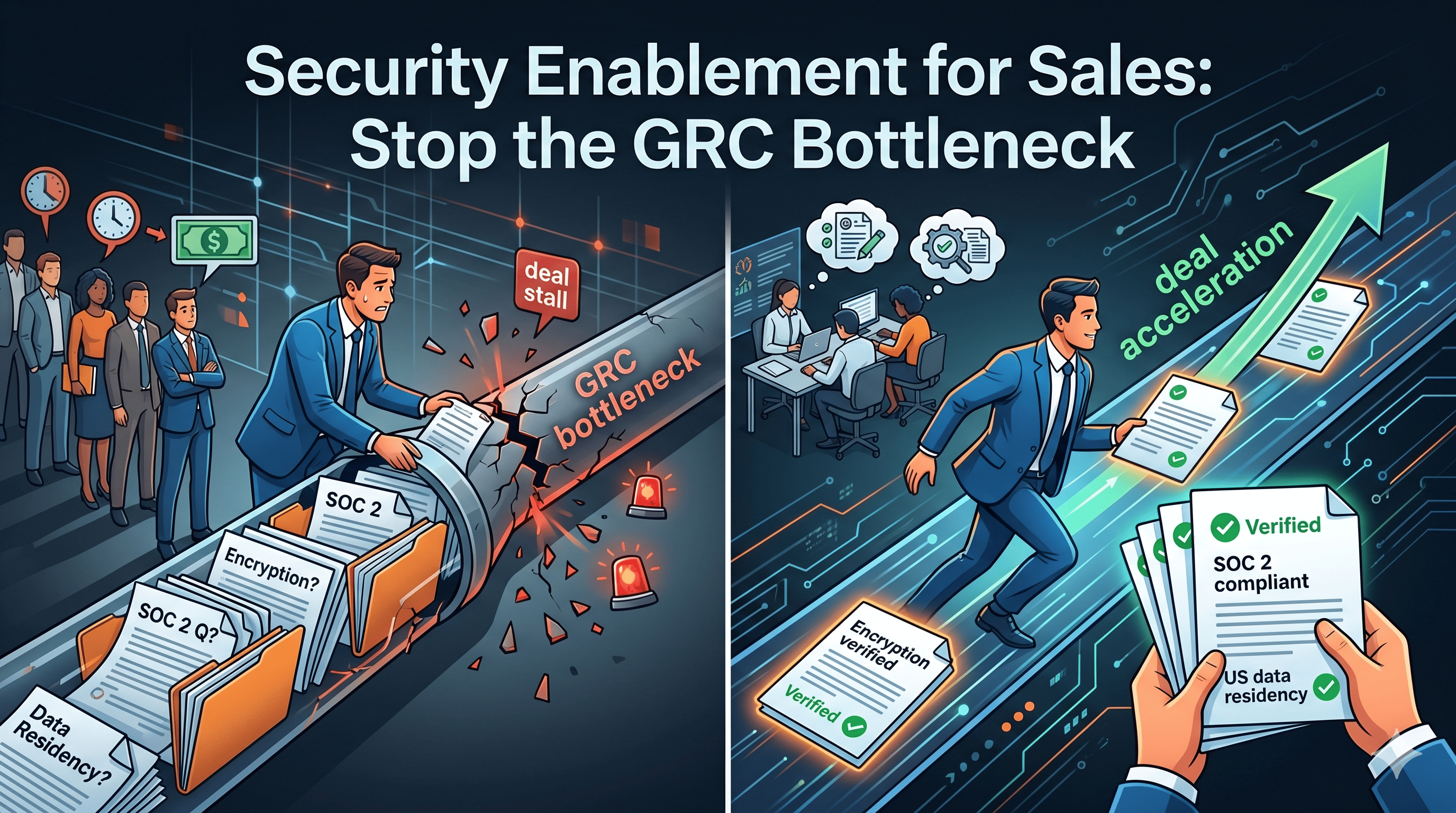
Security enablement for sales teams is the practice of giving sales reps accurate, real-time answers to security questions without forcing them to interrupt the GRC team. When done right, the rep stays unblocked, the GRC team stays focused, and the deal keeps moving. When done wrong, every prospect call that touches security stalls.
It's 2:14pm on a Tuesday. Your sales rep is on a live call with a prospect who handles sensitive financial data. The prospect asks: "Are you SOC 2 Type II compliant? Where is our data stored? What encryption do you use at rest?"
The rep knows the answer to the first question. Maybe. The second and third? No chance.
So the rep does one of three things. They give a vague answer that erodes confidence. They say, "I'll get back to you on that," and kill the momentum. Or they Slack the GRC team mid-task, hoping someone is available.
None of these is a good outcome. And the volume of these moments is greater than most teams realize: of the 100,000+ security questions Skypher has processed, 71.2% arrive as Excel files, 19.2% come through online portals like OneTrust and Archer, and 9.6% as Word documents. That's the formal questionnaire volume. The informal "quick security question on a call" volume is on top of that, and it lands directly on the sales team first.
Why GRC teams become the sales security bottleneck
Here's the dynamic that plays out at most SaaS and tech companies. The GRC team is small. Two people, sometimes three. They're responsible for maintaining compliance posture, managing audits, responding to security questionnaires, updating policies, and handling vendor risk assessments.
They are not sitting around waiting for sales reps to ping them.
But that's exactly what the sales team needs them to be. The sales team operates on a different clock, set by the prospect's calendar. When a prospect asks a security question on a live call, the window to give a confident answer is measured in seconds.
The GRC team's clock is set by audit deadlines, questionnaire queues, and project timelines. These two clocks rarely sync up. Without security enablement for sales in place, the GRC team becomes a synchronous dependency for an asynchronous job.
The hidden cost of delayed security answers in sales
When a sales rep can't answer a security question in real time, the damage is subtle but real. Three costs compound at once.
First, the prospect loses confidence. Security buyers are evaluating whether your company takes this seriously. A hesitant answer or a "let me check" signals that your team doesn't have its act together. Even if you follow up with the right answer two hours later, the impression is already set.
Second, the deal slows down. Every "I'll get back to you" adds a round trip. The rep sends a Slack message. The GRC person sees it between tasks, types a response, the rep relays it over email. What could have been settled in 30 seconds on a call now takes a day. Multiply that across a pipeline and you're looking at real revenue impact.
Third, the GRC team gets fragmented. Every interruption pulls someone out of deep work. Answering a security questionnaire requires focus. When a GRC analyst is halfway through a 200-question assessment and gets pinged for a quick answer, they lose context. The "quick" answer takes 2 minutes, but the context switch costs 20. This is the deeper reason your security questionnaire knowledge base keeps failing — it isn't built to serve sales conversations, only audit ones.
Why sales is the GRC team's most important internal customer
This framing matters. If you run a GRC function at a SaaS company, your sales team is one of your primary internal customers. They depend on your knowledge to close deals. When the GRC team is a bottleneck, deals stall.
But the solution isn't "be more available." You can't scale human availability with a two-person team. And hiring another GRC analyst just to answer ad hoc questions from sales is not a realistic budget conversation.
The solution is to decouple the sales team's need for answers from the GRC team's availability. That decoupling is what security enablement for sales actually delivers.
What real security enablement for sales looks like
There are a few practical approaches, and the best teams combine more than one.
A searchable security knowledge base. Your GRC team already knows the answers to 90% of the questions sales reps get asked: SOC 2 status, data residency, encryption standards, subprocessor lists, incident response timelines. These answers don't change week to week. Put them in a searchable format that sales reps can access during calls. A purpose-built smart security knowledge base eliminates a huge percentage of interruptions on its own.
A Slack integration for self-service security answers. Sales reps live in Slack. If they can type a question in a channel and get an accurate, sourced answer back in seconds, they never need to interrupt anyone. The GRC team maintains the source content. The tool serves the answers. The rep stays unblocked.
An AI agent trained on your security posture. This is where the real shift happens. Instead of maintaining a static FAQ, you feed your completed questionnaires, policies, and security documentation into a system that can answer new questions accurately. The sales rep asks "Do we support SAML SSO?" and gets a precise answer with the source document referenced. No human in the loop. This is also how teams deflect 30% of security questionnaires through an automated trust center — the same source of truth serves both prospects and reps.
The key word in all of these is "accurate." A self-service tool that gives wrong answers is worse than no tool at all. The GRC team needs to trust that what the sales team is getting is correct. That means the system needs to pull from verified, up-to-date sources, not generate answers from thin air.
Why GRC teams gain the most from sales security enablement
Here's what's counterintuitive: the biggest beneficiary of self-service security answers isn't the sales team. It's the GRC team.
When sales reps stop interrupting with one-off questions, the GRC team gets uninterrupted blocks of time. Those blocks are where real work happens. Completing questionnaires. Preparing for audits. Updating policies. Building the compliance infrastructure that actually protects the company.
This is why teams like Adobe, Deel, and McKinsey use Skypher to centralize their security knowledge. Adobe went from spending two weeks on a single security questionnaire to completing them in about two hours. With 200+ enterprise customers and 96% answer accuracy across every major format, Skypher's security questionnaire automation platform gives the GRC team one source of truth that sales, presales, and customer-facing teams can all draw from. The time savings doesn't just come from automating the questionnaire itself. It comes from the GRC team being able to focus without constant context switches from sales.
How to roll out security enablement for sales in practice
If you're a GRC lead reading this, here's a practical path forward.
Start by auditing the questions your sales team actually asks. Pull the last month of Slack messages, emails, and meeting notes where a sales rep asked you a security question. You'll find that 80% of them are the same 20 questions.
Document those answers in a format your sales team can search. Even a shared Google Doc is better than nothing. A dedicated tool is better than a Google Doc. For a longer playbook on structuring this process, see Skypher's best practices for automating your security questionnaire response process.
Then evaluate whether an AI-powered solution can handle the long tail. The 20% of questions that aren't in your FAQ are the ones that still require judgment. But a well-trained system with access to your completed questionnaires and policies can handle most of those too.
The goal is simple: your sales team should be able to get accurate security answers without requiring a human from the GRC team to be available at that exact moment. The GRC team stays focused. The sales team stays unblocked. Deals move forward.
That's not a nice-to-have. For a growing SaaS company with enterprise buyers, security enablement for sales is operational infrastructure.
FAQ
What is security enablement for sales?
Security enablement for sales is the set of tools, content, and workflows that let sales reps answer security questions in real time without pulling in the GRC team for every request. It typically combines a searchable security knowledge base, a Slack or browser integration, and an AI layer trained on your completed questionnaires and policies.
Why does the GRC team become a sales bottleneck?
The GRC team is usually two or three people responsible for audits, questionnaire queues, and policy work — none of which is interruptible. When sales reps need answers during live calls, the synchronous request collides with deep-focus GRC work. Without self-service security answers, every "quick question" costs the GRC analyst around 20 minutes of lost context for a 2-minute answer.
How do you answer security questions on sales calls without slowing the deal?
The fastest path is a self-service security knowledge base the rep can search during the call, backed by an AI agent that pulls from completed questionnaires and policies. Reps get an accurate, sourced answer in seconds, the prospect keeps confidence, and the GRC team is never interrupted.
Can AI handle presales security questions accurately?
Yes, when the AI is grounded in your verified security documentation rather than generating answers from scratch. Skypher reaches 96% answer accuracy by pulling from a maintained knowledge base of completed questionnaires, policies, and trust center content — which is also why teams like Adobe cut questionnaire turnaround from two weeks to two hours.
Should sales reps have direct access to security documentation?
They should have access to a curated layer designed for them, not the raw policy library. The GRC team maintains a single source of truth; the sales-facing tool surfaces only the answers that are approved, current, and phrased for a prospect-facing context. That separation keeps reps fast without compromising what the GRC team certifies as accurate.