.webp)


Over 80 percent of American companies face delays in sales cycles due to slow security questionnaire processes. When every day counts and clients expect fast responses, outdated workflows create major hurdles for even the most organized teams. Understanding how to audit and automate every step of your security questionnaire workflow will help your American business deliver faster, more accurate results without sacrificing compliance or quality.
Table of Contents
- Step 1: Assess Current Security Questionnaire Workflows
- Step 2: Deploy RFP Automation Tools And Integrations
- Step 3: Configure AI-Driven Response Templates
- Step 4: Enable Real-Time Collaboration And Communication
- Step 5: Verify Response Accuracy And Optimize Process
Quick Summary
Step 1: Assess Current Security Questionnaire Workflows
Successfully automating your security questionnaire process begins with a comprehensive evaluation of your existing workflows. This critical first step involves mapping out your current response strategies and identifying bottlenecks that slow down your security review cycles.
Start by conducting a detailed audit of your security questionnaire management process. Gather documentation from different teams and analyze how security questionnaires are currently handled. Streamlining security questionnaire responses requires understanding the full lifecycle from initial request to final submission. Focus on tracking key metrics like average response time, number of team members involved, and frequency of manual data entry.
Pay special attention to communication patterns and information retrieval methods. Map out how security information is sourced across different departments and identify redundant steps where automation could significantly reduce manual effort. Some organizations discover they spend hours manually copying and pasting responses or searching through disconnected document repositories. By documenting these current workflows, you create a clear blueprint for targeted improvement and strategic automation implementation.
A pro tip for this assessment stage: create a visual workflow diagram that highlights each touchpoint and potential friction point in your current security questionnaire process. This visual representation will help stakeholders understand exactly where time and resources are being consumed and make a compelling case for implementing more efficient solutions.
Step 2: Deploy RFP Automation Tools and Integrations
Successfully deploying RFP automation tools requires a strategic approach that transforms your proposal response workflows. This critical step involves selecting the right technology and implementing integrations that streamline your entire security questionnaire process.
Sophisticated RFP automation software assists enterprises by centralizing product knowledge and leveraging AI to auto fill answers across complex documentation formats. Begin by evaluating automation platforms that offer comprehensive features like centralized information repositories, real time collaboration capabilities, and intelligent response generation. Look for solutions that can seamlessly integrate with your existing tech stack and provide advanced features such as version control, team collaboration tools, and customizable response libraries.

When implementing these tools, focus on creating a standardized approach to information management. Configure your chosen platform to map existing knowledge bases, establish consistent response templates, and set up automated workflows that minimize manual intervention. Pay special attention to access permissions, ensuring that sensitive security information remains protected while enabling efficient team collaboration. A strategic deployment means not just implementing software but transforming your entire approach to security questionnaire management.
Pro tip: Before full implementation, conduct a pilot program with a select team to test the automation tool’s effectiveness. This approach allows you to identify potential integration challenges, train key team members, and refine your workflow before organization wide rollout. Your goal is a seamless transition that reduces response time, improves accuracy, and empowers your team to handle increasingly complex security review processes.
Step 3: Configure AI-Driven Response Templates
Configuring AI-driven response templates represents a transformative approach to streamlining your security questionnaire workflows. This critical step involves creating intelligent, reusable response frameworks that dramatically reduce manual effort and improve consistency across your organization’s security documentation.
Begin by conducting a comprehensive audit of your existing security questionnaire responses. Master RFP Question Response for Security Reviews requires developing a strategic template library that captures your organization’s most common security narratives. Identify recurring question types and develop standardized response templates that can be quickly customized and AI-enhanced. Focus on creating modular response blocks that address specific security domains like infrastructure security, data protection, compliance standards, and incident response protocols.
When developing these templates, prioritize flexibility and precision. Implement AI-powered dynamic response generation that can intelligently adapt base templates to match specific questionnaire contexts. Ensure your templates include placeholders for organization specific details, allowing for rapid personalization while maintaining a consistent core message. Pay close attention to version control, establishing clear processes for template review, approval, and periodic updates to reflect evolving security standards and organizational changes.
Pro tip: Create a centralized template governance framework that includes regular review cycles and clear ownership guidelines. Designate subject matter experts from security, compliance, and legal teams to periodically validate and refresh template content. This approach ensures your AI-driven response templates remain accurate, comprehensive, and aligned with your organization’s latest security posture and regulatory requirements.
Step 4: Enable Real-Time Collaboration and Communication
Streamlining security questionnaire workflows demands robust real-time collaboration mechanisms that connect teams, break down communication barriers, and accelerate response processes. This critical step focuses on creating seamless communication channels that enable instant knowledge sharing and coordinated team efforts.
Implement a centralized communication platform that integrates directly with your RFP automation tools. Best Practices for Automating Your Security Questionnaires Response Process emphasizes the importance of establishing clear communication protocols. Configure shared workspaces where security experts, compliance professionals, and sales teams can simultaneously access and edit response templates, provide real-time feedback, and track document progress. Leverage collaboration features like live commenting, version tracking, and instant notification systems to ensure every team member remains informed and aligned.
Prioritize secure and transparent communication channels that maintain strict access controls and audit trails. Design your collaboration infrastructure to support granular permissions, allowing different team members to view, edit, or approve content based on their organizational role. Integrate communication tools with your existing security infrastructure to maintain compliance and data protection standards. Establish clear guidelines for external stakeholder communication, defining precise workflows for sharing sensitive security information while maintaining confidentiality.
Pro tip: Develop a communication matrix that clearly outlines response ownership, review timelines, and escalation procedures. Conduct periodic training sessions to familiarize team members with collaboration tools and communication protocols, ensuring smooth and efficient interactions during high-pressure security questionnaire response scenarios.
Step 5: Verify Response Accuracy and Optimize Processes
Verifying response accuracy represents the critical final stage in your RFP automation strategy, ensuring that every generated security questionnaire meets the highest standards of precision, compliance, and organizational integrity. This pivotal step transforms raw automated responses into polished, reliable documentation that builds trust with potential clients and stakeholders.
Advanced compliance and quality checks provide a comprehensive framework for validating automated responses against multiple dimensions of accuracy. Implement a multi tiered verification process that includes automated syntax and content validation, followed by expert human review. Configure your AI systems to cross reference responses against your organization’s established knowledge base, compliance guidelines, and historical response archives. Pay special attention to maintaining consistent brand voice, technical precision, and legal compliance throughout the validation workflow.
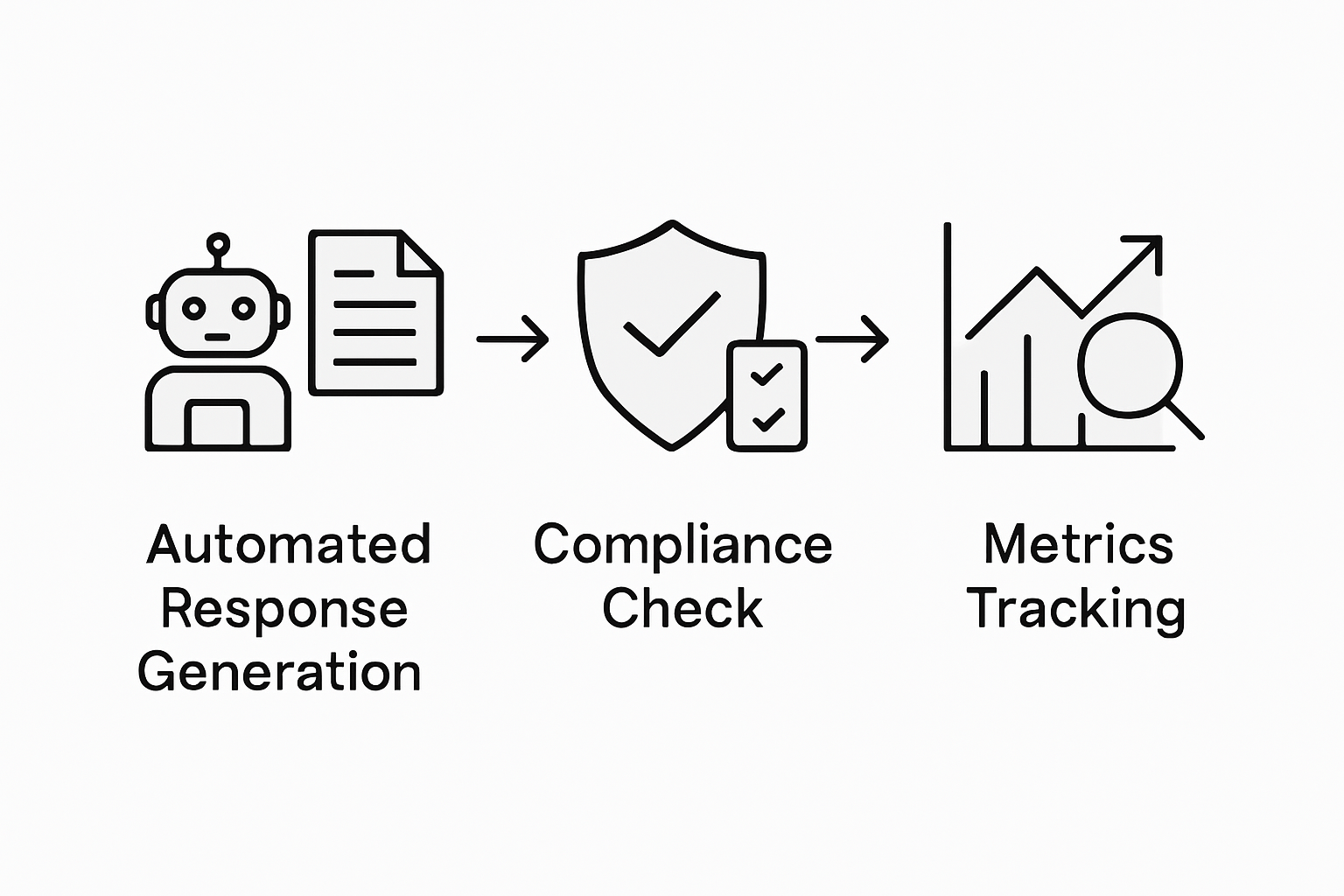
Establish a robust metrics tracking system to continuously improve your response generation processes. Monitor key performance indicators such as response completion time, accuracy rates, and review cycle durations. Conduct periodic retrospective analysis to identify systemic optimization opportunities, tracking metrics like the number of questionnaires processed, average turnaround time, and resources consumed. Create a feedback loop where subject matter experts can provide granular insights that help refine your AI response generation algorithms and templates.
Pro tip: Develop a structured scoring mechanism that rates each automated response across multiple dimensions including technical accuracy, completeness, tone consistency, and compliance adherence. Use these scores to create continuous improvement triggers that automatically flag responses requiring additional review or refinement, ensuring your security questionnaire automation maintains the highest possible quality standards.
Accelerate Your Security Questionnaire Responses with Skypher
The challenges highlighted in the article such as manual workflows, fragmented communication, and lengthy verification cycles are precisely why many medium to large tech and finance organizations struggle with efficient security questionnaire automation. You need a solution that combines AI-driven response templates, real-time team collaboration, and robust integrations to eliminate bottlenecks and enhance accuracy throughout your RFP process.
Skypher offers an industry-leading AI Questionnaire Automation Tool that transforms cumbersome security reviews into streamlined workflows at scale. With over 30 API integrations to trusted platforms like ServiceNow and OneTrust, multilingual support, and powerful Slack and Microsoft Teams connectivity, your teams can collaborate seamlessly while dramatically reducing completion time even for the most complex questionnaires.

Ready to master RFP automation and accelerate your security reviews? Discover how Skypher’s customizable Trust Center, 24/7 enterprise support, and intelligent content management can enhance every step of your security response process. Visit Skypher now and start transforming your security questionnaire management today.
Frequently Asked Questions
How can I assess my current security questionnaire workflows?
To assess your current security questionnaire workflows, conduct a detailed audit of your response processes. Document how security questionnaires are managed, track key metrics, and identify bottlenecks that slow down your review cycles.
What steps should I take to deploy RFP automation tools effectively?
Start by selecting RFP automation tools that centralize information and offer features like real-time collaboration. Create a standardized approach for information management, automate workflows, and ensure sensitive information is safeguarded during the implementation process.
How do I create AI-driven response templates for security questionnaires?
Begin by auditing your existing responses to identify common question types. Develop a library of standardized response templates that can be easily customized using AI, ensuring they are flexible and allow for quick personalization to specific queries.
What are best practices for enabling real-time collaboration in my security questionnaire process?
Establish a centralized communication platform integrated with your RFP tools to facilitate teamwork. Configure shared workspaces, implement live commenting, and set clear protocols for document tracking to enhance communication and collaboration across teams.
How can I verify the accuracy of automated responses in security questionnaires?
Implement a multi-tiered verification process with both automated validation and human review to ensure response accuracy. Set up a metrics tracking system to monitor performance and continuously improve your response quality through systematic feedback and review cycles.