.webp)


Sorting through endless security questionnaires can feel like a never-ending cycle for IT compliance managers, especially as regulatory demands shift across global markets. Manual methods often slow down operations and leave too much room for human error. By exploring automated compliance technologies, leaders can transform routine security assessments with real-time verification, intelligent analysis, and adaptive learning. This article clarifies the fundamentals, exposes common misconceptions, and highlights best practices to help your organization achieve greater compliance efficiency while supporting accuracy and oversight.
Table of Contents
- Automated Compliance Fundamentals And Misconceptions
- Core Technologies And Key Workflow Features
- Major Compliance Frameworks And Legal Drivers
- Real-World Integration: SaaS And Risk Platforms
- Roles, Responsibilities, And Common Pitfalls
- Risks, Limitations, And Alternatives Compared
Key Takeaways
Automated Compliance Fundamentals and Misconceptions
Automated compliance represents a transformative approach to managing complex regulatory requirements, leveraging advanced technologies to streamline security review processes. By integrating artificial intelligence and machine learning, organizations can now address regulatory challenges with unprecedented efficiency and accuracy.
Traditional compliance methods often struggle with rapidly evolving regulatory landscapes. Modern approaches, however, utilize sophisticated techniques that can extract rules from unstructured texts through intelligent parsing and contextual analysis. These systems go beyond simple rule matching by incorporating adaptive learning mechanisms that continuously improve their understanding and interpretation of complex regulatory frameworks.
Key characteristics of effective automated compliance systems include:
- Real-time verification of regulatory adherence
- Scalable processing across multiple regulatory domains
- Adaptive learning capabilities
- Continuous improvement through feedback loops
- Ability to handle ambiguous or complex regulatory language
Despite significant technological advancements, organizations must recognize that automated compliance is not a complete solution. Ethical decision-making frameworks emphasize the importance of human oversight and critical evaluation. Automation should augment, not replace, human judgment in complex regulatory environments.
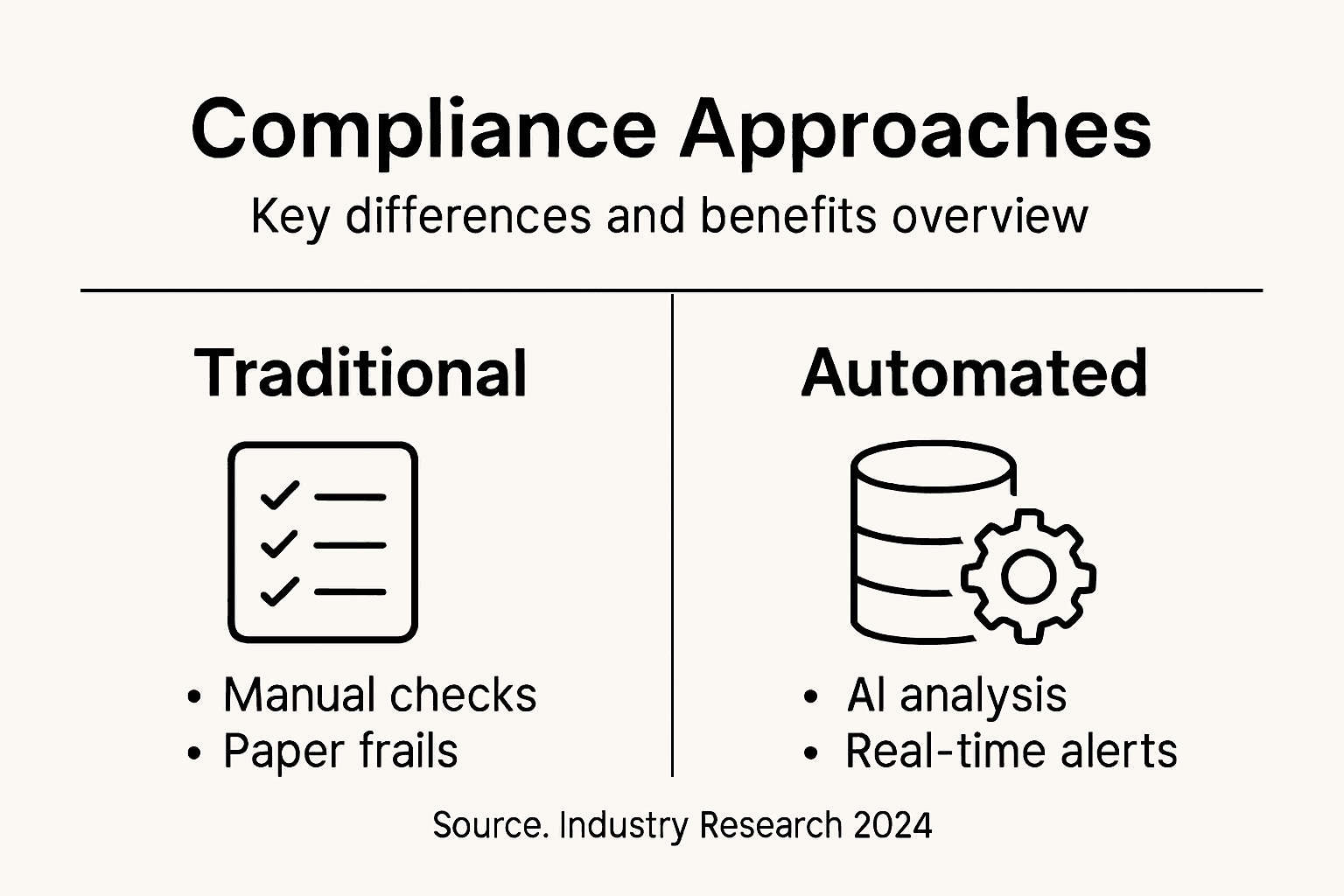
Here’s a comparison of traditional compliance approaches versus automated compliance technologies:
Pro tip: Implement a hybrid approach that combines automated tools with human expertise to maximize compliance effectiveness and maintain nuanced regulatory interpretation.
Core Technologies and Key Workflow Features
Modern automated compliance technologies represent a sophisticated approach to managing complex regulatory requirements, transforming traditional security review processes through advanced technological integration. Intelligent compliance systems leverage multiple cutting-edge technologies to create comprehensive, adaptive frameworks that respond dynamically to evolving regulatory landscapes.
The core technological infrastructure includes AI-driven vulnerability scanning and regulatory management capabilities that fundamentally reshape how organizations approach risk mitigation. These systems utilize sophisticated technologies such as:
- Robotic Process Automation (RPA)
- Natural Language Processing (NLP)
- Machine Learning algorithms
- Configurable rule engines
- Real-time monitoring platforms
Key workflow features distinguish modern compliance technologies from traditional approaches. Data analytics and process automation enable organizations to transform compliance from a reactive checkpoint into a proactive, continuous improvement mechanism. This shift allows businesses to embed compliance directly into operational workflows, reducing manual intervention and minimizing potential human error.
Advanced compliance technologies focus on creating integrated, intelligent systems that can:
- Automatically collect and validate regulatory evidence
- Perform continuous risk assessments
- Adapt to changing regulatory requirements
- Unify disparate compliance management systems
- Generate comprehensive audit trails
Pro tip: Implement a multi-layered compliance technology strategy that combines AI-powered tools with human expertise to create a robust, adaptive regulatory management framework.
Major Compliance Frameworks and Legal Drivers
Navigating the complex landscape of regulatory compliance requires a comprehensive understanding of multiple interconnected legal frameworks that govern organizational operations across various industries. These frameworks establish critical standards for data protection, financial reporting, cybersecurity, and ethical business practices, creating a structured approach to managing regulatory risks.
Regulatory frameworks in accounting and cybersecurity demonstrate the intricate relationships between different compliance domains. Key international standards include:
- ISO 27001 for Information Security Management
- NIST Cybersecurity Framework
- International Financial Reporting Standards (IFRS)
- Financial Accounting Standards Board (FASB) guidelines
- General Data Protection Regulation (GDPR)
Legal drivers emerge from multiple sources, compelling organizations to adopt rigorous compliance strategies. Comprehensive compliance matrices reveal the complex reporting requirements and enforcement mechanisms that span diverse sectors. These legal imperatives address critical areas such as:
- Data privacy protection
- Non-discrimination policies
- Financial transparency
- Cybersecurity risk management
- Ethical business conduct
Organizations must recognize that compliance is not a static process but a dynamic, evolving ecosystem that demands continuous adaptation. Successful compliance strategies integrate multiple frameworks, creating holistic approaches that anticipate regulatory changes and proactively address potential risks.
The following table summarizes major international compliance frameworks and their primary focus areas:
Pro tip: Develop a cross-functional compliance team that regularly reviews and updates regulatory requirements across different frameworks to maintain comprehensive organizational compliance.
Real-World Integration: SaaS and Risk Platforms
The evolving landscape of enterprise risk management demands sophisticated Software-as-a-Service (SaaS) solutions that seamlessly integrate compliance, security, and operational workflows. These advanced platforms transform traditional risk management approaches by providing comprehensive, real-time visibility into organizational vulnerabilities and regulatory requirements.
Governance, Risk, and Compliance (GRC) platforms have revolutionized how organizations approach regulatory adherence. These intelligent systems offer critical capabilities such as:
- Centralized risk management tracking
- Automated compliance monitoring
- Continuous framework validation
- Role-based access controls
- Standardized policy workflows
Modern SaaS risk platforms support multiple international standards, enabling organizations to maintain robust compliance across complex regulatory environments. These systems provide seamless integration capabilities that allow businesses to:
- Synchronize data across multiple platforms
- Generate comprehensive audit reports
- Prioritize security remediation efforts
- Implement real-time monitoring protocols
- Adapt to evolving regulatory requirements
The most effective risk management platforms go beyond simple checklist approaches, offering dynamic, intelligence-driven solutions that anticipate potential vulnerabilities and proactively address emerging compliance challenges. By leveraging advanced analytics and machine learning, these tools transform compliance from a reactive task to a strategic organizational capability.

Pro tip: Select SaaS risk platforms that offer flexible integration capabilities and support multiple regulatory frameworks to maximize your compliance efficiency and adaptability.
Roles, Responsibilities, and Common Pitfalls
Effective automated compliance requires a nuanced understanding of organizational governance that goes far beyond traditional technological implementations. Success hinges on creating clear accountability structures and defining precise roles that align technological capabilities with strategic organizational objectives.
AI governance accountability structures have become increasingly complex, demanding sophisticated approaches to role definition and responsibility allocation. Key organizational roles critical to successful compliance automation include:
- Chief Compliance Officer (CCO)
- Information Security Director
- Legal and Risk Management Specialists
- Technology Implementation Team
- Governance and Ethics Coordinators
Common pitfalls in compliance automation emerge from unclear role definitions and coordination challenges across different organizational departments. Responsible AI implementation requires strategic leadership that can bridge technological capabilities with ethical considerations. Organizations frequently encounter obstacles such as:
- Fragmented communication between departments
- Lack of clear escalation protocols
- Insufficient cross-functional training
- Inadequate risk assessment mechanisms
- Challenges in proving comprehensive compliance
Successful compliance strategies demand a holistic approach that integrates technological solutions with human expertise. This requires creating adaptive governance frameworks that can evolve alongside emerging regulatory requirements and technological innovations.
Pro tip: Establish a dedicated cross-functional compliance team with clearly defined roles, regular training programs, and robust communication channels to mitigate governance risks.
Risks, Limitations, and Alternatives Compared
Automated compliance technologies represent a powerful yet nuanced approach to organizational risk management, requiring careful navigation of potential technological vulnerabilities. Understanding the inherent risks and limitations is crucial for developing robust, responsible implementation strategies that balance technological innovation with ethical considerations.
Algorithmic risks in governance present complex challenges that extend beyond simple technological implementation. Key risks organizations must address include:
- Unintended algorithmic biases
- Transparency and accountability gaps
- Privacy breach potential
- Societal impact limitations
- Potential for unintended discriminatory outcomes
Automated compliance risk mitigation demands a comprehensive approach that goes beyond technological solutions. Alternative strategies to manage these risks include:
- Implementing human oversight mechanisms
- Developing continuous monitoring protocols
- Creating transparent algorithmic decision-making frameworks
- Establishing cross-functional governance committees
- Regularly auditing automated systems for potential biases
Organizations must recognize that automated compliance is not a one-size-fits-all solution. The most effective approaches blend technological capabilities with human expertise, creating adaptive frameworks that can evolve with changing regulatory landscapes and technological innovations.
Streamline Your Automated Compliance with Skypher’s AI-Driven Solutions
The article highlights the complexities and challenges of managing automated compliance across evolving regulatory landscapes. Organizations often face slow manual processing, fragmented communication, and the need for real-time monitoring in security reviews. Skypher addresses these pain points with its AI Questionnaire Automation Tool, designed to accelerate the security questionnaire process while enhancing accuracy and collaboration. By leveraging proprietary AI models and over 30 API integrations with popular risk management platforms, Skypher ensures your compliance workflows stay adaptive, efficient, and error-free.

Ready to transform your security reviews into a proactive, continuous compliance program? Discover how Skypher’s customizable Trust Center and real-time collaboration capabilities can minimize manual effort and improve regulatory adherence. Stop spending hours on repetitive questionnaires and start focusing on strategic compliance tasks today. Visit Skypher now and empower your teams with tools built for complex enterprise environments. Learn more about our AI Questionnaire Automation Tool and explore how seamless API Integrations can simplify your governance and risk workflows.
Frequently Asked Questions
What is automated compliance?
Automated compliance leverages advanced technologies, including artificial intelligence and machine learning, to efficiently manage regulatory requirements and streamline security review processes.
How do automated compliance systems improve efficiency?
These systems improve efficiency by providing real-time verification of regulatory adherence, scalability across multiple domains, adaptive learning capabilities, and reducing manual intervention in compliance processes.
What are some key features of automated compliance technologies?
Key features include AI-driven vulnerability scanning, natural language processing, continuous risk assessments, and the ability to generate comprehensive audit trails.
What are the risks associated with automated compliance?
Risks include potential algorithmic biases, privacy breach potential, transparency gaps, and the need for human oversight to ensure ethical accountability.
Recommended
- 7 Essential Steps for a Security Compliance Checklist
- Complete Guide to Software Compliance Software
- Cybersecurity GRC: Essential Strategies for 2025 Success
- IT Security Management System: Enhancing Trust and Efficiency
- Staying Compliant: Financial Automation and Regulatory Requirements - BankStatementFlow Blog
- GDPR Compliant Testing in 2025: No Cookies, No Problems