.webp)


Most American companies now face relentless cyber threats from every angle, with over 60 percent reporting at least one significant security incident each year. Digital assets have become primary targets, making robust information security management more vital than ever. Understanding exactly what defines a strong IT security management system can help safeguard your organization’s future, guiding smarter risk management and building confidence in your overall cybersecurity strategy.
Table of Contents
- Defining IT Security Management Systems
- Types and Core Functions Explained
- Automation and AI in Security Operations
- Compliance, Governance, and Legal Requirements
- Risks, Mistakes, and Best Practice Approaches
Key Takeaways
Defining IT Security Management Systems
An Information Security Management System (ISMS) represents a strategic framework designed to protect an organization’s most critical digital assets through systematic risk management and proactive security controls. Organizations increasingly recognize that cybersecurity is not just a technical challenge, but a comprehensive approach requiring structured policies, procedures, and ongoing monitoring.
At its core, an ISMS provides a structured methodology for managing sensitive information and mitigating potential security risks. According to TechTarget’s comprehensive definition, an ISMS serves as a systematic framework of policies and procedures intended to systematically manage sensitive data while minimizing organizational risk. This approach ensures that security measures are not merely reactive, but strategically aligned with broader business objectives.
The primary components of an effective ISMS typically include:
- Risk Assessment: Identifying potential vulnerabilities and threat landscapes
- Policy Development: Creating comprehensive security guidelines
- Access Controls: Managing user permissions and authentication mechanisms
- Continuous Monitoring: Implementing real-time threat detection and response protocols
- Compliance Management: Ensuring adherence to industry-specific regulatory requirements
Moreover, a robust ISMS goes beyond technical controls. As defined by the National Academies Press, it encompasses a comprehensive set of practices designed to protect information assets while maintaining confidentiality, integrity, and availability. This holistic approach means that security is not just about preventing breaches, but creating a resilient organizational culture that understands and proactively manages digital risks.
Types and Core Functions Explained
Information Security Management Systems (ISMS) are not one-size-fits-all solutions but rather adaptable frameworks designed to meet unique organizational security requirements. Research from leading academic sources reveals multiple established frameworks, each offering distinct methodological approaches to protecting digital infrastructure and managing cybersecurity risks.
Three prominent ISMS frameworks dominate the cybersecurity landscape:
- ISO/IEC 27001: An internationally recognized standard providing comprehensive guidelines for establishing, implementing, maintaining, and continually improving an information security management system
- NIST Cybersecurity Framework: A flexible approach emphasizing risk management and adaptable security strategies across different industry sectors
- COBIT (Control Objectives for Information and Related Technologies): A governance framework focusing on aligning IT strategies with broader business objectives
Each framework shares core functional elements that form the backbone of effective security management. These fundamental components typically include systematic risk assessment, policy development, control implementation, continuous monitoring, and ongoing improvement. The McCumber Cube model provides an additional lens for understanding these functions, emphasizing the critical intersection of confidentiality, integrity, and availability across different information states.

The practical application of these frameworks requires a holistic approach that transcends traditional technical boundaries. Successful ISMS implementation demands not just technological solutions, but a comprehensive strategy integrating people, processes, and technology. This means developing robust security protocols, training personnel, establishing clear communication channels, and creating adaptive systems capable of responding to emerging digital threats with agility and precision.
Automation and AI in Security Operations
Artificial Intelligence and automation have revolutionized cybersecurity operations, transforming how organizations detect, respond to, and mitigate digital threats. Groundbreaking research in machine learning applications demonstrates the profound evolution of AI technologies in enhancing security capabilities, particularly in areas like intrusion detection, malware classification, and intelligent security policy management.
The core advantages of AI-driven security operations include:
- Rapid Threat Detection: AI algorithms can analyze massive datasets exponentially faster than human analysts
- Predictive Security Modeling: Machine learning models can anticipate potential vulnerabilities before they are exploited
- Automated Incident Response: Intelligent systems can execute predefined mitigation strategies with minimal human intervention
- Continuous Learning: AI systems constantly refine their threat detection capabilities by analyzing new attack patterns
Cybersecurity research from leading academic institutions highlights how integrating automation and AI enables organizations to proactively identify and mitigate emerging threats. This approach transforms security from a reactive model to a dynamic, predictive ecosystem capable of adapting to sophisticated cyber risks in real time.
Modern AI-powered security platforms leverage advanced techniques like anomaly detection, behavioral analysis, and predictive modeling to create comprehensive defense mechanisms. By combining machine learning algorithms with AI-powered recommendation engines, organizations can develop intelligent security infrastructures that not only protect against known threats but also anticipate and neutralize potential future risks with unprecedented accuracy and speed.
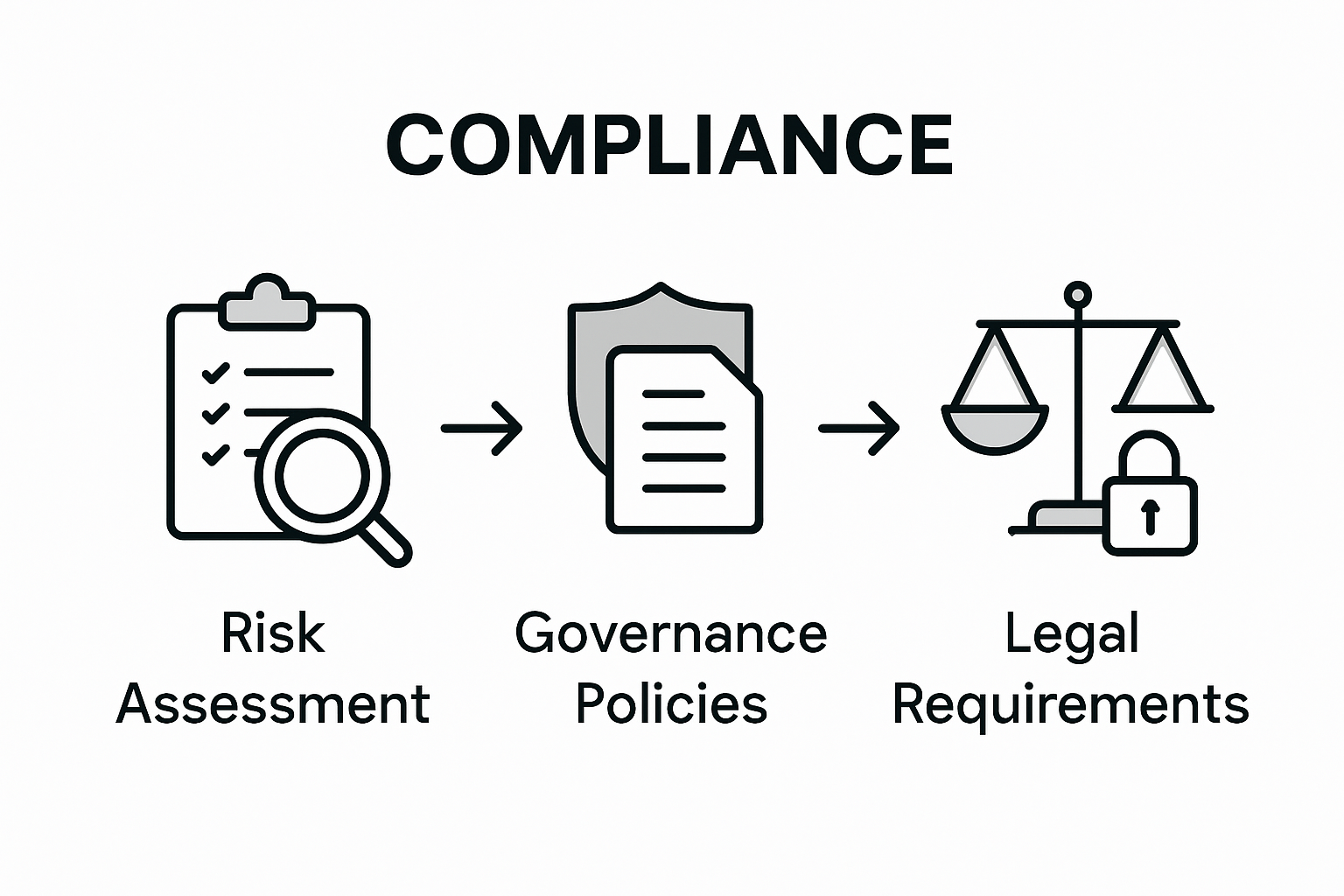
Compliance, Governance, and Legal Requirements
Governance, Risk, and Compliance (GRC) represent critical pillars of modern information security management, creating a comprehensive framework that ensures organizations meet complex regulatory obligations while protecting sensitive information assets. Research from leading academic sources underscores the critical importance of adhering to established information security standards like ISO/IEC 27001 and NIST frameworks to maintain robust legal and regulatory compliance.
Key compliance and governance components typically include:
- Regulatory Mapping: Identifying applicable legal requirements across different jurisdictions
- Risk Assessment: Systematically evaluating potential compliance vulnerabilities
- Policy Development: Creating comprehensive guidelines that align with industry standards
- Audit Trail Management: Maintaining detailed documentation of security controls and processes
- Continuous Monitoring: Implementing real-time compliance tracking mechanisms
Comprehensive research on information security management emphasizes that effective compliance strategies involve more than simple checklist adherence. Organizations must develop dynamic, adaptive GRC frameworks that can rapidly respond to evolving regulatory landscapes and emerging technological challenges.
Navigating the complex terrain of legal requirements demands a proactive and integrated approach. Modern organizations must recognize that compliance is not a static destination but a continuous journey of risk management, technological adaptation, and strategic governance. By implementing robust information security management systems that prioritize transparency, accountability, and comprehensive risk mitigation, businesses can transform regulatory compliance from a potential burden into a strategic competitive advantage.
Risks, Mistakes, and Best Practice Approaches
Information Security Risk Management represents a critical strategic discipline that requires organizations to proactively identify, assess, and mitigate potential vulnerabilities. A structured methodology for security risk assessment emphasizes the importance of systematically evaluating potential threats and implementing robust control mechanisms to protect organizational assets.
Common security risks and potential mistakes organizations frequently encounter include:
- Inadequate Access Controls: Failing to implement robust authentication and authorization protocols
- Insufficient Employee Training: Neglecting human factor vulnerabilities in cybersecurity
- Legacy System Vulnerabilities: Maintaining outdated technological infrastructure
- Incomplete Incident Response Plans: Lacking comprehensive strategies for managing security breaches
- Incomplete Vendor Risk Management: Overlooking third-party security risks
Comprehensive research on information security management highlights that effective risk mitigation requires a holistic approach. Organizations can enhance their security posture by developing comprehensive strategies that address technological, human, and procedural vulnerabilities. When developing risk management strategies, leaders must recognize that cybersecurity is not a one-time implementation but a continuous process of adaptation, learning, and improvement.
Successful risk management demands a proactive and integrated approach. By cultivating a culture of security awareness, implementing robust technological controls, and maintaining flexible response mechanisms, organizations can transform potential vulnerabilities into opportunities for strengthening their overall security infrastructure. The most resilient organizations view risk management not as a compliance requirement, but as a strategic advantage that enables innovation while protecting critical assets.
Transform Your IT Security Management with Speed and Accuracy
Managing complex security questionnaires is a critical challenge highlighted in the article. The manual effort involved can slow down your risk assessments, compliance workflows, and governance, risking inaccuracies and inefficiency. To overcome these pain points Skypher offers an AI-powered Questionnaire Automation Tool that accelerates your security reviews—answering hundreds of questions in under a minute with exceptional precision. This means less time spent on repetitive tasks and more focus on strengthening your Information Security Management System.

Experience how Skypher’s intelligent automation enhances your risk management, compliance, and collaboration processes. With real-time integration across platforms like ServiceNow and Slack, plus customizable Trust Centers that boost client trust, your organization can move faster while improving security posture. Visit Skypher now to revolutionize your security questionnaire process and build stronger client relationships today.
Frequently Asked Questions
What is an Information Security Management System (ISMS)?
An Information Security Management System (ISMS) is a systematic framework designed to protect an organization’s sensitive information through structured risk management, policies, procedures, and continuous monitoring.
How does an ISMS address cybersecurity risks?
An ISMS addresses cybersecurity risks by conducting risk assessments to identify vulnerabilities, developing policies to mitigate those risks, implementing access controls, and ensuring compliance with industry regulations.
What are the key components of an effective ISMS?
Key components of an effective ISMS include risk assessment, policy development, access controls, continuous monitoring, and compliance management, all aimed at protecting sensitive information while aligning with business objectives.
How can automation and AI improve IT security management?
Automation and AI improve IT security management by enabling rapid threat detection, predictive security modeling, automated incident response, and continuous learning to adapt to evolving cyber threats.
Recommended
- Understanding SOC 2 AICPA: Your Guide to Compliance
- 7 Steps to Create a Complete SOC 2 Compliance Checklist
- Smart Security Knowledge Base | Security Questionnaire Automation | Skypher
- Complete Guide to SOC Type II Reports