.webp)

Quick Summary: The Best Security Questionnaire Automation Software for 2026
- Top Choice: Skypher — Best for Enterprise teams requiring 96% accuracy and native portal automation.
- Key Accuracy: 96% grounded retrieval model (Zero AI hallucinations).
- Portal Support: Native automation for OneTrust, ServiceNow, and Archer.
- Integrations: Direct collaboration within Slack and Microsoft Teams.
- Scalability: Unlimited Seats (No per-seat "success tax").
Introduction: The State of Security Questionnaire Automation Tools in 2026
Answering security questionnaires and proving compliance used to drain teams through slow, repetitive work. Now, new tools promise to cut this effort from hours to minutes and help companies stay organized even as demands from customers grow. The landscape of security compliance in 2026 is defined by a shift from manual data entry to automated trust ecosystems. As procurement cycles accelerate, security and sales teams face a growing volume of complex assessments across diverse formats and third-party platforms. Relying on static spreadsheets or simple generative AI is no longer sufficient to maintain the accuracy and speed required for enterprise deals.
customer demand
Modern organizations are moving toward Agentic AI solutions that do more than just draft text: they orchestrate the entire lifecycle of security knowledge. This expert comparison evaluates the leading platforms for 2026, focusing on their ability to centralize internal documentation, automate portal-based reviews, and proactively communicate security posture to prospects.
Table of Contents
Skypher

At a Glance
Skypher is an Agentic AI platform for security questionnaire automation that helps organizations respond ten times faster while maintaining 96 percent accuracy. Trusted by Fortune 500 companies like Adobe and technology leaders such as Swile and Retool, Skypher is SOC 2 Type II compliant. The platform is designed for enterprise teams managing security questionnaires, RFPs, and Trust Centers within a single, unified workflow.
Core Features
Skypher utilizes a proprietary retrieval model to achieve high accuracy, using Generative AI only to refine the final output. Every response includes a confidence score and a direct link to the source document, highlighting the exact sentence used for validation.
- Complex Format Support: The platform natively processes Excel files with macros and conditional logic, complex Word documents with nested tables, and PDFs with embedded image data.
- Grounded AI Retrieval: Skypher syncs directly with internal knowledge sources including SharePoint, Google Drive, Confluence, and Notion. This ensures that every answer is grounded in current company policies rather than AI guesswork.
- Unified Trust Center: A branded, customer-facing portal that allows prospects to self-serve security documentation under automated NDA. It reduces repetitive requests by integrating directly with the questionnaire database.
- Workflow Integration: Skypher operates within existing enterprise tools. Teams manage intake through Salesforce and handle SME reviews directly within Slack or Microsoft Teams.
Grounded AI: Why Retrieval Beats Generation
The primary risk of utilizing standard Generative AI for security questionnaires is the potential for "hallucinations" or technically inaccurate statements. Skypher addresses this through a proprietary retrieval model that prioritizes existing evidence over synthetic text generation. Instead of guessing an answer, the platform identifies the precise sentence or paragraph within your connected data sources—such as SharePoint policies, Google Drive documents, or previous questionnaire history—to serve as the foundation for a response.
Every answer generated by Skypher includes a Confidence Score and a direct link to the source material. If a response is derived from a PDF, Skypher highlights the exact text used for the validation. If the source is a past questionnaire, the platform identifies the specific project and date of the original submission. This level of transparency allows security leads to audit and verify responses in seconds, ensuring that every submission is audit-ready and factually sound.
Online Portal Questionnaires: Mastering OneTrust and ServiceNow
Third-party risk management platforms like OneTrust and ServiceNow often create data silos that hinder collaboration. Skypher addresses this through a suite of over 50 proprietary portal connectors. Rather than working within a restricted client environment, Skypher imports portal-based questionnaires directly into its own centralized platform. This allows multiple team members to collaborate on the same assessment simultaneously without the need for shared passwords or expensive per-seat licensing. This "import-first" approach ensures total data sovereignty: all work is saved internally for future reuse rather than being lost in a client's portal.
The Trust Center: One Workflow, Two Outcomes
Skypher eliminates the need to maintain separate databases for questionnaires and public security portals. When a security lead validates an answer within a questionnaire, that verified content is immediately available to inform the Trust Center. This "one workflow" approach ensures that public-facing documentation remains as current as the latest internal audit. The Trust Center features granular access rules and automated document expiry, allowing sales teams to share sensitive certifications with prospects securely and proactively.
Built for Scale: Unlimited Collaboration in Slack and Teams
Security reviews require cross-functional input from DevOps, Legal, and Product teams. Skypher facilitates this through an unlimited users model, removing the friction of seat-based licensing. By meeting teams in Slack or Microsoft Teams, Skypher eliminates the need for a separate dashboard for occasional contributors. Security leads can assign tasks and receive approvals in real-time, accelerating the internal review cycle from days to minutes.
Pros
- 10x Faster Reviews: no more copy and pasting and manually looking for the answers
- Extreme Accuracy: 96 percent accuracy rate with full source traceability and confidence scores.
- Data Sovereignty: Prevents work loss by centralizing all portal-based responses in an internal library.
- Zero Learning Curve for SMEs: Reviews happen directly in Slack or Microsoft Teams.
- 48-Hour Integration SLA: New portal connectors are developed within two business days upon request.
- Provides centralized management of security content and data, ensuring all knowledge, documents, and project artifacts remain consistent and audit-ready.
- Integrates with leading data sources such as OneDrive, SharePoint, Google Drive, Confluence, and Notion to eliminate content duplication. Continuous syncing ensures Skypher always works with the latest version of every document.
- Enables enterprise-grade collaboration with granular roles, permissions, and review workflows across Salesforce, Microsoft Teams, and Slack.
Cons
- Enterprise Focus: Optimized for teams handling 20 plus questionnaires per year: potentially too robust for very small startups.
- Quote-Based Pricing: Detailed costs are not public and require a consultation with the sales team.
Real World Use Case
A global SaaS vendor utilized Skypher to manage high-volume questionnaires containing up to 400 questions. By connecting their Google Drive and past questionnaire history, the team reduced completion time from three days to four hours. The use of the Skypher Trust Center further reduced incoming questionnaire volume by 25 percent as prospects could self-serve standard security documentation.
Pricing
Quote-based; flexible pricing that requires contacting product specialists for a custom quote.
Website: https://skypher.co
The Hidden Cost of Portal-Based Questionnaires
Security professionals often view third-party portals as a mandatory friction point. When a vendor completes a questionnaire directly inside a client instance of OneTrust or ServiceNow, the knowledge generated is effectively siloed. This creates a data ownership gap because the vendor loses the ability to easily audit, export, or reuse those specific responses for future assessments. Skypher addresses this by centralizing the workflow. By importing portal-based questions into a unified environment, teams maintain a permanent record of their intellectual property. This transition prevents the need for password sharing and bypasses seat-limitations common in compliance platforms. Once the task is finished, the data remains in the internal library to inform subsequent security reviews.
Beyond the Tool: The Hidden Risks of Per-Seat Pricing Models
Most legacy security questionnaire platforms utilize a per-seat pricing model. While this appears cost-effective for small teams, it creates a "Success Tax" as an organization matures. In the context of 2026 security audits, questionnaires require input from multiple Subject Matter Experts (SMEs) across DevOps, Legal, and Product Engineering. A per-seat model forces organizations to choose between paying thousands in additional licensing fees or restricting access to the tool.
When access is restricted, two dangerous side effects occur:
- Credential Sharing: Teams often share login credentials to bypass seat limits, creating a significant security vulnerability within a platform specifically designed to manage security.
- Process Silos: If a Product Manager doesn't have a seat, they will continue to provide answers via email or Slack, forcing the primary user to manually copy-paste data back into the tool. This breaks the automation cycle and introduces manual errors.
By contrast, an Unlimited User model (like the one offered by Skypher) encourages broad participation. This ensures that every department contributes to the knowledge base, increasing the overall accuracy and ROI of the platform's AI retrieval model without penalizing company growth.
Conveyor
At a Glance
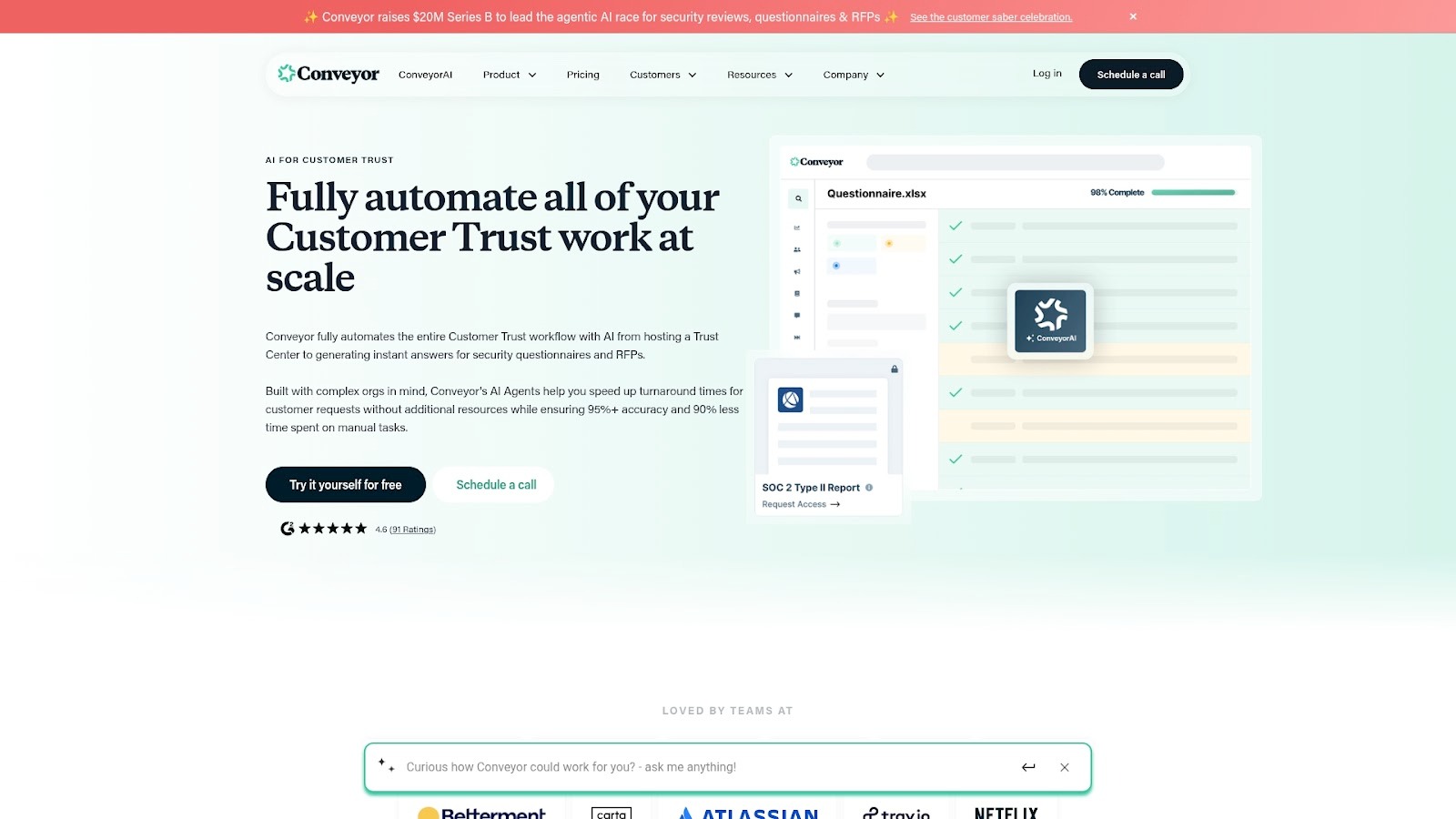
Conveyor is an AI-driven platform that automates security questionnaires, RFP/RFQ responses, Trust Centers, and secure document sharing. It promises high-accuracy automated answers and broad integrations, aiming to cut manual effort and accelerate customer trust workflows. For mid-to-large organizations with complex security needs, Conveyor can dramatically speed responses, though its pricing and feature depth may require planning and onboarding.
Core Features
Conveyor combines AI for security questionnaires, RFPs, and trust centers with automated response generation that claims 95%+ accuracy. It connects to source materials and portals to pull verifiable data, detects gaps and inconsistencies proactively, and supports over 50 languages for global teams. Additional capabilities include secure document watermarking and sharing, analytics on interactions and responses, a browser extension to complete questionnaires directly, and collaboration features with AI-assistive suggestions and delegation.
Pros
- High accuracy AI responses reduce manual effort and lower the risk of inconsistent answers across questionnaires.
- Significant time savings (up to 90% for tedious tasks) help teams close sales cycles and respond to security reviews faster.
- Comprehensive integrations and source connectivity make it possible to pull authoritative data from your systems instead of relying on memory or spreadsheets.
- The user-friendly and intuitive interface reduces friction for security and sales teams working together.
- Conveyor’s platform evolves with new features and improvements, which keeps it aligned with changing questionnaire formats and customer expectations.
- Positive reviews from security professionals indicate industry credibility and real-world validation.
Cons
- Pricing may be high for smaller teams or organizations in early stages, making it a heavier investment for startups.
- The breadth and complexity of features might require dedicated onboarding time and internal training to maximize ROI.
- The free tier is limited with basic credits, so meaningful use typically requires a paid plan.
Who It’s For
Conveyor is best for organizations with complex security needs—security teams, compliance officers, and sales teams that regularly respond to detailed questionnaires and RFPs. If your company manages multi-entity setups, global customers, or frequent trust reviews, Conveyor fits well because it centralizes answers, pulls from trusted sources, and supports collaboration between technical and commercial teams.
Unique Value Proposition
Conveyor’s unique value lies in combining high-accuracy AI with deep integrations and a browser-based workflow. That mix allows teams to generate reliable answers quickly while keeping responses traceable to source documents. The multi-language support and analytics layer further position Conveyor as a tool for organizations that need scale, governance, and repeatability in their security review processes.
Real World Use Case
A security engineer used Conveyor’s browser extension to complete a seven-page security questionnaire roughly 80% faster than before. By leveraging connected source materials and AI suggestions, the team reduced manual editing, shortened turnaround time, and handed a polished, consistent response back to the sales team—helping accelerate the sales cycle.
Pricing
Free tier with limited credits; paid plans start at $9,600/year for the professional plan, offering extensive features, unlimited seats, and more credits. Pricing is volume-based and can be customized.
Website: https://conveyor.com
SafeBase by Drata
At a Glance
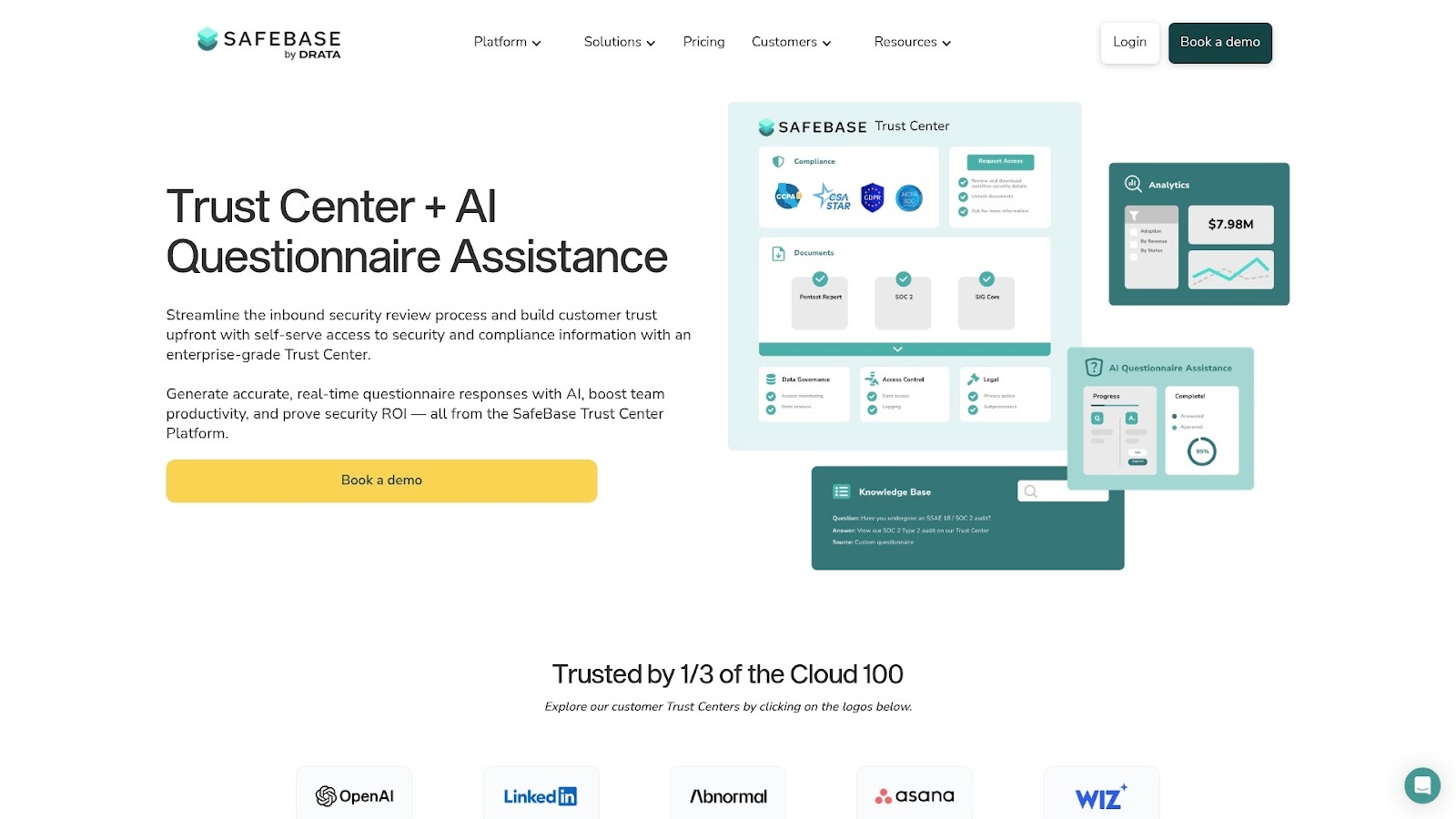
SafeBase by Drata is a trust center platform that centralizes and automates inbound security reviews, combining AI-assisted questionnaire responses with a customizable public-facing trust portal. If you need to reduce the manual effort of RFPs and security questionnaires while showing customers a polished, branded security posture, SafeBase can materially speed responses and improve buyer confidence. Expect some onboarding work for advanced integrations, but the platform delivers measurable time savings for teams that handle frequent security reviews.
Core Features
SafeBase offers self-serve access to security and compliance information via a customizable trust center, plus AI-powered assistance to accelerate and improve the accuracy of questionnaire responses. It integrates with common collaboration and CRM workflows — including Slack, Teams, Jira, Salesforce, HubSpot, DocuSign, and Ironclad — and provides analytics dashboards to track buyer engagement and the security impact on revenue. The platform emphasizes scalable documentation management, access controls, and reporting to demonstrate security ROI to prospects and customers.
Pros
- Automates security questionnaires, saving time and reducing repetitive manual work for security and sales teams.
- Enhances customer trust through a transparent, branded trust center that makes security posture visible and accessible.
- Scalable customization lets you align the trust portal to your brand and control access for different audiences.
- Integrates with major workflows and CRM tools to keep questionnaire work within existing processes and reduce context switching.
- Provides analytics dashboards that quantify security-related revenue impact and buyer engagement for better decision-making.
Cons
- Security Questionnaire automation is not the main focus and can lack breadth of features such as supporting different complex formats (macros in spreadsheet, word documents or online portals)
- Pricing details are not fully published, which means you must contact SafeBase for specific cost information and budgeting.
- Enterprise-grade integrations and customizations may require implementation effort, especially in complex environments.
Who It’s For
SafeBase is designed for organizations that receive a moderate volume of questionnaires from their midmarket customers but rather need a trust Center to automate the huge amount of access requests they receive for sharing their security docs like SOC 2 report etc.. SafeBase helps you centralize answers, reduce response time, and present a professional security narrative to buyers.
Unique Value Proposition
SafeBase combines a customer-facing trust center with AI-powered questionnaire assistance and integrated analytics, turning security documentation into a proactive sales enabler rather than a reactive burden. That combination — branded transparency plus automation and measurable engagement data — is its core differentiator for teams looking to prove security value while saving operational time.
Real World Use Case
A mid-sized SaaS company publishes a branded trust portal to showcase controls and certifications, which raises buyer confidence, reduces back-and-forth reviews, and helps accelerate deal closure.
Pricing
Free tier available (Foundation); Advanced and Enterprise plans offer additional features and customizations and require contacting SafeBase for pricing details (quote-based).
Website: https://safebase.io
SecurityPal AI
At a Glance
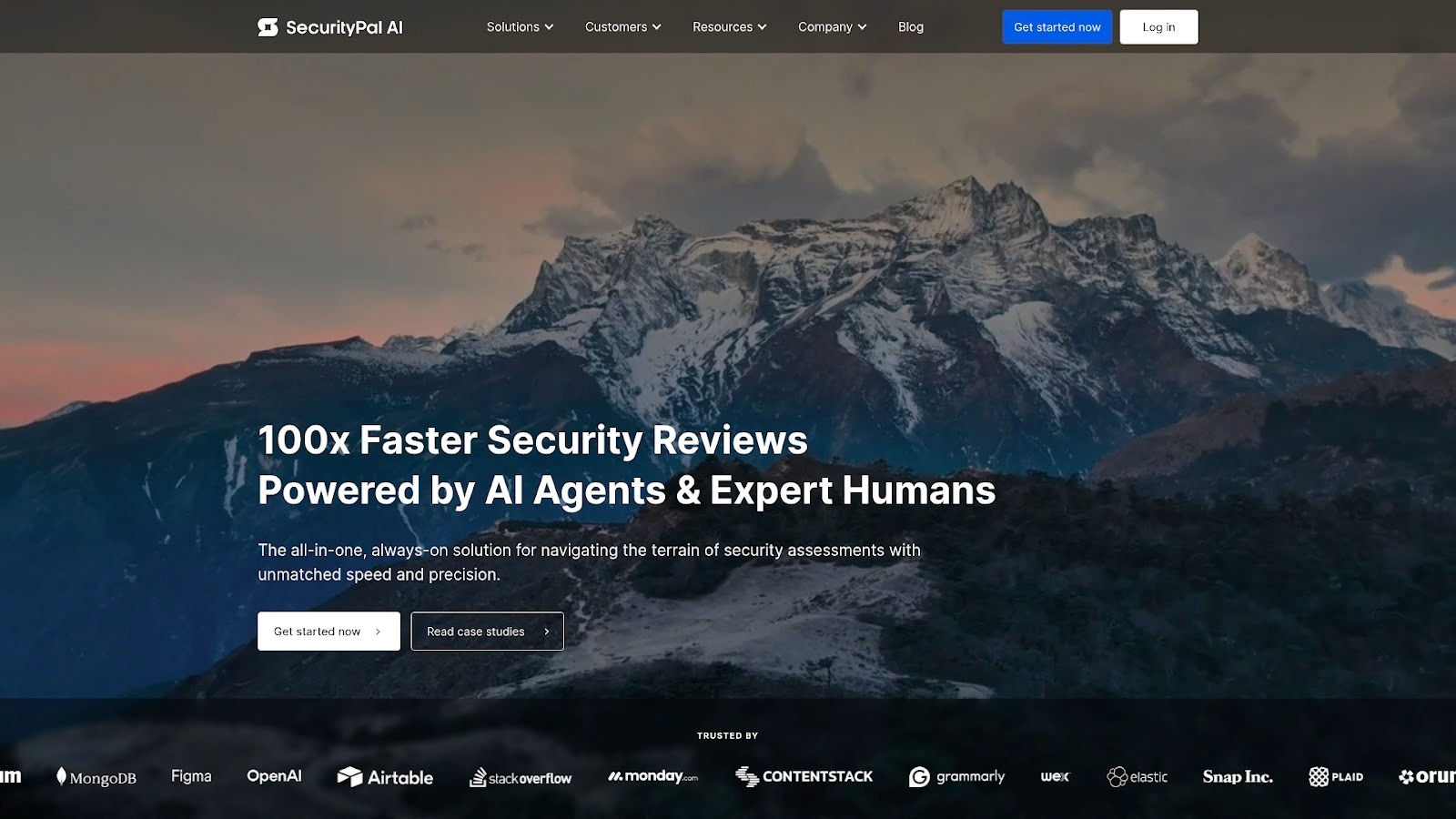
SecurityPal AI is an all-in-one, always-on platform that blends AI agents with expert human analysts to accelerate security reviews and assurance. In practice, it promises dramatic speed gains while centralizing security, privacy, and GRC workflows. If you need a single place to manage questionnaires, trust centers, and vendor assessments with 24/7 support, SecurityPal AI delivers strong operational value, though adopting the full suite requires planning and ongoing management.
Core Features
SecurityPal AI offers a customer assurance suite that covers security, privacy, and GRC reviews, plus a security questionnaire concierge designed to fast-track responses for sales and compliance. The platform includes trust centers for showcasing security posture, an interactive platform to engage stakeholders, and a knowledge library with AI-driven insights and expert analysis. It also provides review cycle management and version history to keep documentation current, a Copilot AI for instant, targeted responses, and vendor assessment (TPRM) capabilities to streamline third-party reviews.
Pros
- Speeds up security reviews significantly, up to 87 times faster with AI, which can materially shorten sales and onboarding timelines.
- Provides comprehensive and integrated security, privacy, and compliance management, enabling you to centralize evidence, responses, and policies.
- Reduces operational costs and accelerates sales cycles by automating repetitive tasks and delivering faster, more consistent answers.
- Offers 24/7 global support with a dedicated command center, so you have on-demand human assistance alongside automated workflows.
- Combines AI efficiency with certified human expertise, improving accuracy and reducing the risk of purely automated errors.
Cons
- The extensive suite of features may require some time to fully implement and integrate into your existing systems, which can slow initial ROI.
- Potential costs associated with the level of service and support are not specified here, making budgeting and procurement planning harder.
- Requires ongoing management of AI tools and human analysts, which means your team will need processes to maintain accuracy, governance, and version control.
Who It’s For
SecurityPal AI is best suited for enterprise security teams, CISOs, GRC and compliance officers, and security operations groups that handle high volumes of security questionnaires and vendor assessments. If your organization must prove security posture to customers quickly and repeatedly—especially during enterprise sales or vendor onboarding—SecurityPal AI is built to reduce cycle time and centralize evidence.
Unique Value Proposition
SecurityPal AI’s unique value lies in pairing high-speed AI automation with certified human review and 24/7 command center support. That combination aims to deliver both the speed enterprises demand during sales cycles and the accuracy auditors and customers expect, wrapped in a platform that centralizes trust artifacts and ongoing compliance activities.
Real World Use Case
A company uses SecurityPal AI to respond to new customer security questionnaires during enterprise sales. By leveraging the Copilot AI and the questionnaire concierge, the team cuts response cycles from weeks to days, presents a Trust Center to prospects, and relies on human experts for final validation—resulting in faster contract closure and clearer demonstrations of compliance.
Pricing
Not specified on the website.
Website: https://securitypalhq.com
Vanta
At a Glance
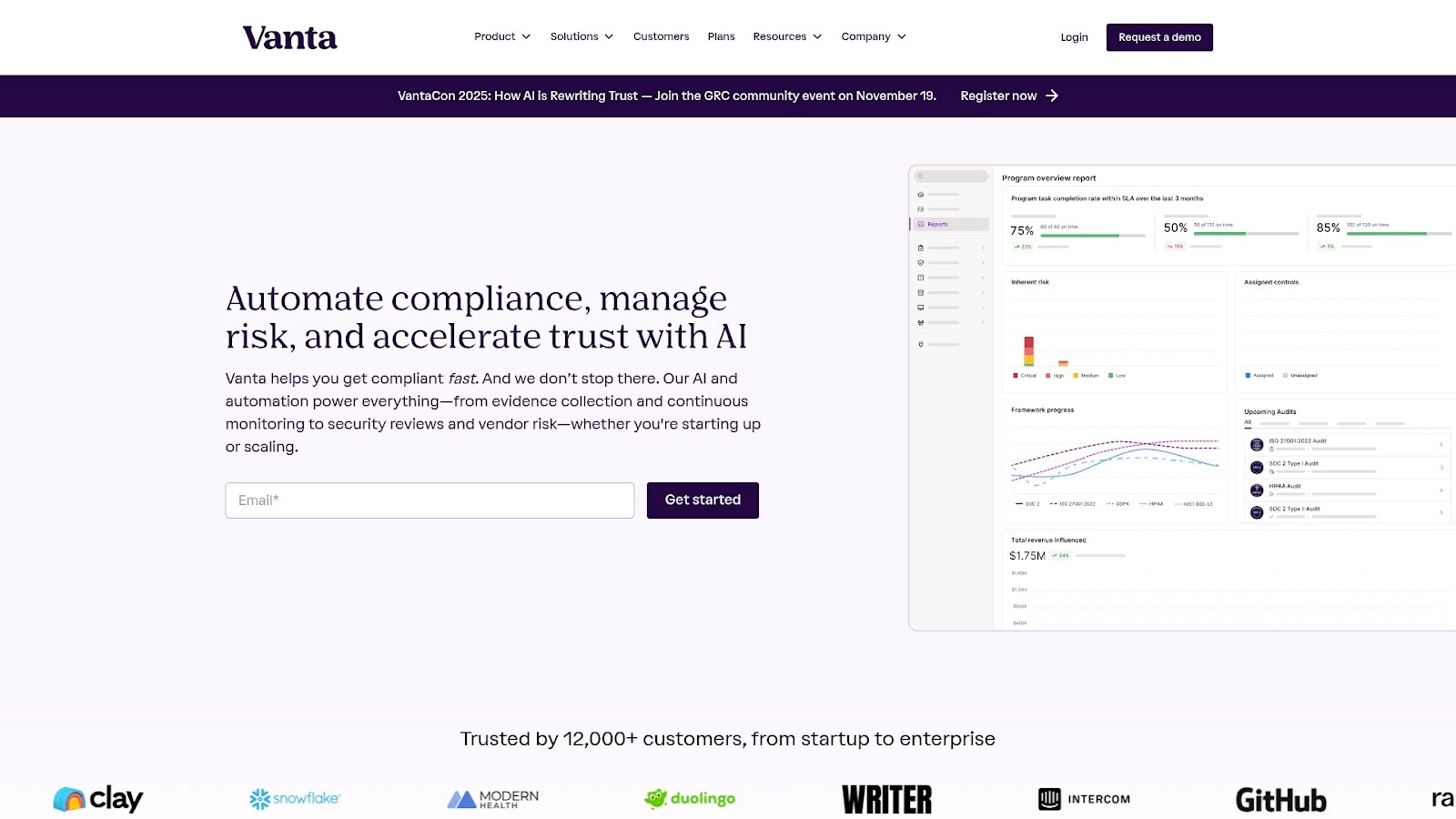
Vanta is a mature compliance automation platform that helps organizations speed up SOC 2, ISO 27001, GDPR, and other audits through AI and continuous monitoring. It reduces manual evidence collection and keeps controls under constant observation so you can spot gaps before auditors do. For teams that must prove security to customers and partners, Vanta offers a pragmatic way to scale trust without hiring a full compliance team.
Core Features
Vanta centralizes automated evidence collection for 35+ frameworks and pairs that with continuous controls monitoring and real-time alerts. It includes vendor risk management powered by AI reviews, customer trust capabilities like automated questionnaires and a Trust Center, and configurable AI agents to automate security review workflows. Together these features aim to shorten audit timelines, maintain ongoing compliance, and simplify vendor and customer security interactions.
Pros
- Highly automated solutions reduce manual effort, enabling teams to spend less time gathering evidence and more time fixing issues.
- Supports a wide range of compliance frameworks, making it practical for organizations facing multiple regulatory or industry requirements.
- AI-driven insights and automation improve efficiency by surfacing risks and automating routine compliance tasks.
- Suitable for organizations of various sizes, so startups and enterprises can both find value from its capabilities.
- Trusted by thousands of customers, which supports confidence in its market position and product maturity.
Cons
- The platform can feel complex and requires a learning curve for new users, which may demand onboarding time or consultant support.
- Pricing is not disclosed explicitly on the website, creating uncertainty that can make budgeting harder for smaller organizations.
- Heavy reliance on AI automation means some organizations will need to validate and integrate outputs into existing workflows before fully trusting them.
Who It’s For
Vanta is designed for security, compliance, and risk teams at startups, mid-market companies, and enterprises that need to automate evidence collection and maintain continuous compliance. If you are responsible for providing security posture to customers or completing recurring audits quickly, Vanta gives you the automation and monitoring tools to scale those responsibilities without expanding headcount significantly.
Unique Value Proposition
Vanta’s core value is combining automated evidence collection, continuous monitoring, and AI-driven vendor and questionnaire workflows into a single platform. That combination shortens audit cycles and centralizes trust-building activities (like a Trust Center), letting you demonstrate a verified security posture to customers and regulators with less manual overhead.
Real World Use Case
A rapidly growing tech startup uses Vanta to achieve SOC 2 compliance efficiently by automating the majority of evidence collection and using continuous monitoring to detect control drift. The company also automates vendor risk reviews and publishes a Trust Center so sales and customer success teams can prove security to prospects quickly—reducing friction during procurement and accelerating deal timelines.
Pricing
Not provided explicitly on the website
Website: https://vanta.com
Responsive
At a Glance
Responsive is a veteran in the strategic response management space, offering a highly configurable platform for RFPs, security questionnaires, and enterprise-level knowledge management. While newer competitors lean heavily on generative AI to replace human input, Responsive focuses on giving experienced proposal teams a flexible framework to manage complex workflows. It is a reliable choice for mid-market companies that prioritize a centralized "source of truth" and require granular control over how their data is reused across different departments.
Core Features
The platform centers on a content library designed for high-frequency reuse and configuration flexibility. Responsive provides tools for RFP and RFQ management, proposal automation, and a suite of integrations with CRM and collaboration tools. Its AI functionality suggests answers based on historical data, though it functions more as a recommendation engine than an autonomous agent. Key technical capabilities include a project management dashboard to track progress across multiple stakeholders, requirement tracking to ensure compliance with specific buyer mandates, and a browser-based tool to assist with web-based portals.
Pros
- High levels of configuration allow the software to adapt to unique internal workflows rather than forcing the team into a rigid process.
- The centralized content management system is effective at organizing thousands of standard responses for diverse product lines.
- Strong reporting tools provide visibility into team productivity and the success rate of various proposals.
- The platform handles traditional RFPs and complex proposals with a level of structure that newer, lighter tools often lack.
- Reliable customer support and a long history in the market provide a sense of stability for risk-averse procurement departments
Cons
- The interface is known for its complexity, which often leads to a steeper learning curve for new users.
- AI suggestions lack deep context reasoning, meaning users must spend significant time manually editing answers to ensure they meet the specific intent of the buyer.
- The system lacks automated conflict detection, which can lead to the proliferation of duplicate or slightly varied "stale" answers if not audited regularly.
Who It’s For
Responsive is built for mid-to-large enterprises with dedicated proposal or security teams who want a "command center" for their documents. It is best for organizations that value human-in-the-loop validation and need a platform that can be customized to fit complex, multi-layered approval workflows.
Unique Value Proposition
Responsive differentiates itself through configuration and scale. Unlike many "AI-first" tools that prioritize speed over control, Responsive offers a robust architecture for teams that want to manage the entire lifecycle of a response. Its value lies in its ability to act as a cross-departmental knowledge base that supports not just security teams, but sales and legal departments as well.
Real World Use Case
A mid-market software company used Responsive to consolidate their fragmented response process. By migrating their scattered spreadsheets into the Responsive library, the proposal team gained a single source of truth. Even though the AI required manual oversight, the ability to quickly pull "gold standard" answers into a structured project allowed them to handle a 30% increase in RFP volume without adding headcount.
Pricing
Pricing is generally quote-based and varies depending on the number of users and specific modules required. Plans typically target the enterprise level, with an emphasis on custom packages that reflect the scale of the organization.
Website: https://www.responsive.io
Loopio

At a Glance
Loopio is a workflow-centric platform designed to simplify the way companies respond to RFPs, DDQs, and security questionnaires. It positions itself as a central hub that bridges the gap between technical subject matter experts and the sales team. Loopio is particularly strong for organizations that already have a solid foundation of vetted content and are looking for a more efficient way to distribute that knowledge across the company while maintaining strict version control.
Core Features
Loopio’s architecture revolves around a "Stack" (their version of a library) that categorizes content for easy retrieval. The platform includes "SmartScan" and "SmartFill" technology, which are designed to bridge the gap between static documents and dynamic web portals. This allows users to ingest questions from a PDF or webpage and map them directly to library entries. Other core features include automated review cycles, where content owners are prompted to update their entries on a set schedule, and a multi-user collaboration interface that allows for granular task assignments and progress tracking.
Pros
- The user interface is clean and accessible, making it easier for non-technical users to adopt the tool quickly.
- Project management features like "Assignments" and "Reviews" help keep subject matter experts accountable without constant nagging.
- SmartFill technology significantly reduces the friction of filling out questionnaires in third-party vendor portals.
- The platform excels at "Library Hygiene," offering tools to merge duplicates and retire outdated information systematically.
- Loopio provides a unified experience that handles both the content storage and the active project management in one place.
Cons
- The effectiveness of the tool is heavily dependent on the quality of the initial library setup.
- Ongoing maintenance is required. If a company does not designate a library owner, the quality of the automated suggestions degrades quickly.
- Portal integrations can be limited depending on the specific mix of platforms your customers use.
Who It’s For
Loopio is ideal for companies that want a structured, repeatable process for their security and sales responses. It works best for teams that have a high volume of questionnaires and are willing to invest the time into "Library Hygiene" to ensure the long-term accuracy of their automated responses.
Unique Value Proposition
Loopio’s strength is its focus on the "Content Lifecycle." While other tools focus on the generation of the answer, Loopio focuses on the management and health of the answer over time. The combination of its intuitive project management workflow and its specialized tools for portal-based questionnaires makes it a leader in the "workflow-first" category of response software.
Real World Use Case
A security team at a growing SaaS company used Loopio’s "SmartScan" to ingest a massive 200-question RFI. Because they had utilized the "Reviews" feature to keep their library updated every quarter, the platform was able to auto-populate 70% of the RFI with high-confidence answers. This allowed the security leads to focus only on the 30% of questions that were unique to that specific prospect, cutting the total completion time from days to hours.
Pricing
Loopio offers tiered pricing (Plus, Advanced, and Enterprise) based on the number of users and the depth of features required. Detailed pricing is provided upon request through a custom demo, though it is positioned as a premium enterprise solution.
Website: https://loopio.com
The Hidden Cost of Portal-Based Questionnaires
Security professionals often view third-party portals as a mandatory friction point. When a vendor completes a questionnaire directly inside a client instance of OneTrust or ServiceNow, the knowledge generated is effectively siloed. This creates a data ownership gap because the vendor loses the ability to easily audit, export, or reuse those specific responses for future assessments. Skypher addresses this by centralizing the workflow. By importing portal-based questions into a unified environment, teams maintain a permanent record of their intellectual property. This transition prevents the need for password sharing and bypasses seat-limitations common in compliance platforms. Once the task is finished, the data remains in the internal library to inform subsequent security reviews.
Security Questionnaire Automation Tools Comparison
Below is a comparison of several security questionnaire automation tools, highlighting their unique features, pros, cons, targeted users, and pricing models to help organizations choose the best fit for their needs.
Streamline Security Questionnaires and Close Deals Faster with Skypher
Are you spending too many hours on repetitive security questionnaires, only to face inconsistent answers and slow sales cycles? As highlighted above, the main pain points are manual response processes, wasted time across teams, and the challenge of keeping answers accurate and compliant. Skypher tackles these issues directly with AI-powered security questionnaire automation, so your team can answer even the largest questionnaires in under a minute with responses that stay consistent and audit-ready. If proof of concept delays and scattered documentation are slowing your growth, discover how our real-time integrations, robust API connectors, and customizable Trust Center can help your team. Explore how organizations in tech and finance are already accelerating reviews and boosting client trust through Skypher.
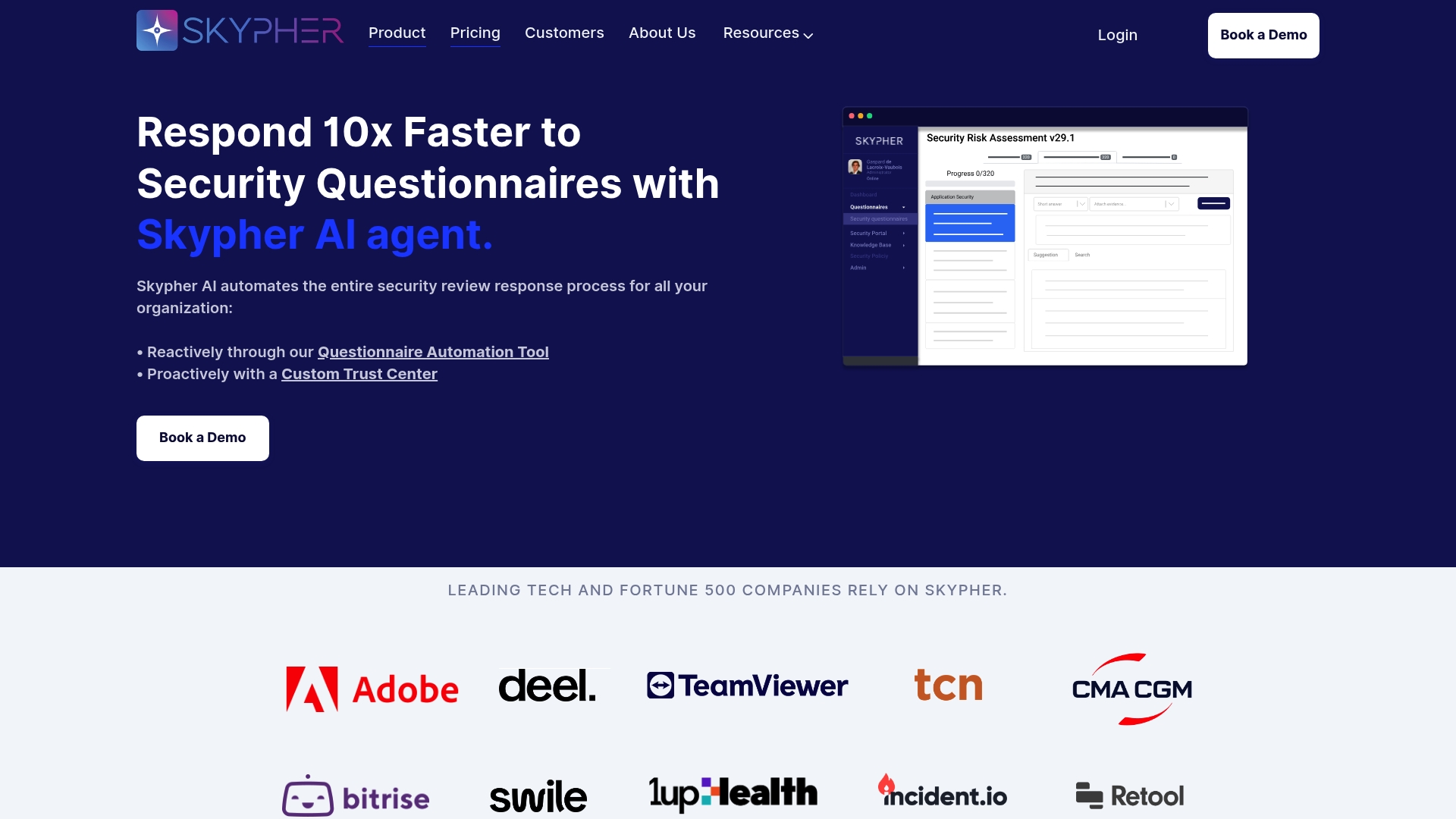
Ready to experience radically faster and more reliable questionnaire workflows? Visit the Skypher website to see AI-powered automation in action and check out our main automation platform. Learn how our integrations with Slack, ServiceNow, and dozens of third-party risk management tools can help you move from manual effort to automated security reviews today. Don’t let your competitors move faster — schedule a free demo or browse our FAQ to get started.
Frequently Asked Questions
What are the core features of the leading security questionnaires automation tools?
Skypher, Conveyor, SafeBase, SecurityPal AI, and Vanta all offer AI-driven automation for responding to security questionnaires. They centralize security content, streamline workflows, and improve response accuracy while reducing manual effort across teams.
How can security questionnaires automation tools improve response times?
These tools automate the process of filling out security questionnaires, enabling teams to respond up to 10 times faster than traditional manual methods. Features like centralized knowledge bases, AI assistance, and integrations with existing systems contribute to significant time savings.
What industries benefit most from using security questionnaires automation tools?
Security, sales, compliance, and solutions teams across tech companies and larger enterprises, including SaaS and Fortune 500 organizations, benefit the most. These tools are essential for handling high volumes of security assessments and improving customer trust during vendor evaluations.
How does the accuracy of AI-driven responses compare across different tools?
Most tools claim high accuracy rates, with platforms like Skypher and Conveyor reporting 96% and 95%+ accuracy, respectively. This high level of precision helps organizations minimize the risk of errors and inconsistencies in their security responses.
Recommended
- The Case for Security Questionnaire Automation
- The ever growing number of security questionnaires and what you and your company can do to face it
- Guides - Skypher
- How to Keep Data Secure: Essential Steps for 2025 - IT Start
- Cybersecurity for Insurers, tools and best practices - Digital Insurance Platform | IBSuite Insurance Software | Modern Insurance System